




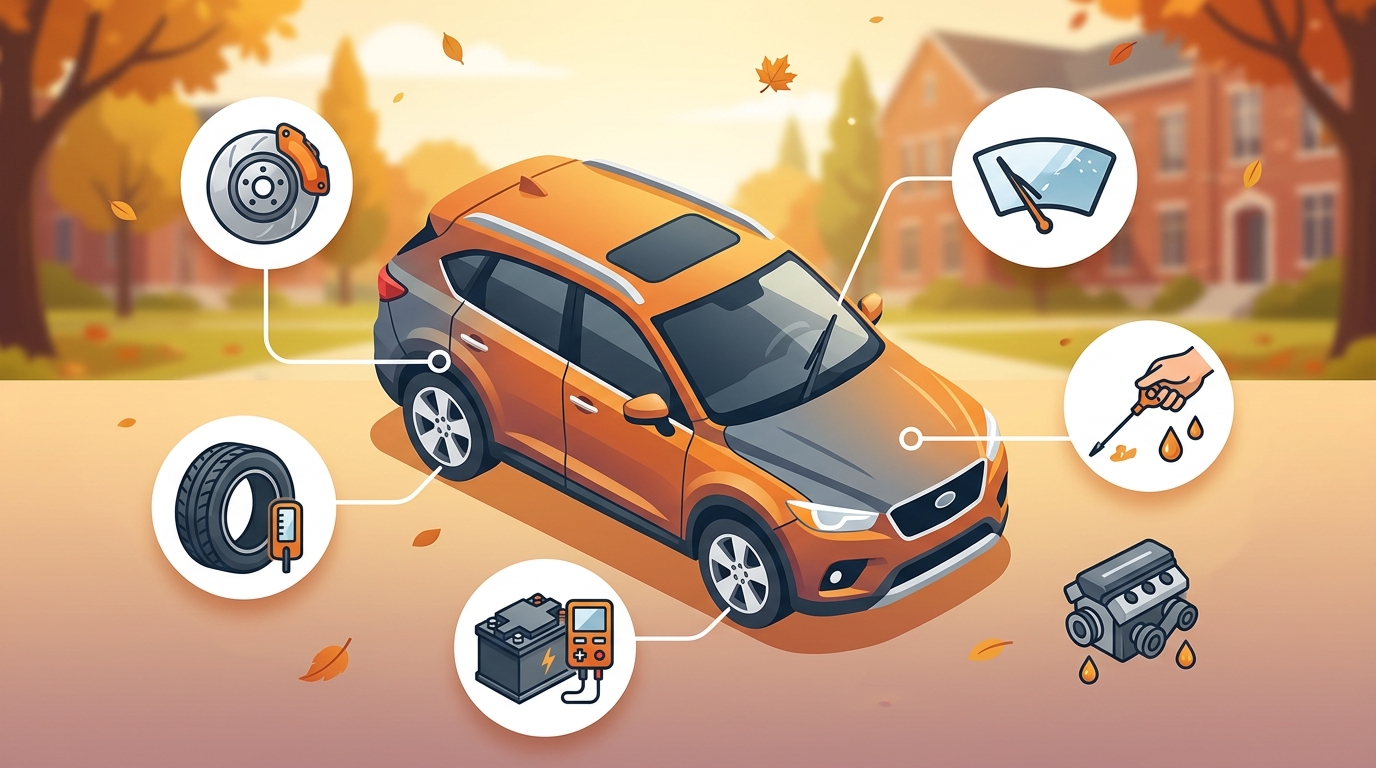
College students heading into the fall semester should complete a thorough vehicle inspection covering brake system condition, tire inflation and tread depth, 12V battery charge, vital fluid levels, exterior lighting, and wiper blade performance. Performing this baseline maintenance prevents roadside breakdowns, protects engine longevity during highway trips, and ensures vehicle safety across changing autumnal weather before arriving on campus.
Preparing a vehicle for campus life requires shifting from occasional summer driving to consistent commuting and long-distance travel. When packed with luggage, school supplies, and dorm furniture, a car operates under increased weight, putting extra stress on acceleration, stopping performance, and tire sidewalls. Addressing lingering mechanical issues prior to departure minimizes the chances of facing emergency repairs far from home.
A comprehensive fall maintenance checklist covers both professional service checks and simple preventative steps:
- Brake system inspection, including pad thickness, rotor smoothness, and fluid moisture levels
- Tire condition evaluation, checking cold pressure, tread wear indicators, and spare tire inflation
- Electrical system test measuring resting voltage and battery cranking output
- Vital fluid checks for engine oil, coolant, brake fluid, power steering fluid, and washer fluid
- Complete exterior lighting check and windshield wiper inspection
Parents and students driving out of Waynesboro along local rural routes can schedule a complete pre-trip inspection at our Waynesboro service facility or give our service department a quick call to verify maintenance intervals before hitting the road.
Table of Contents
- What Key Safety Systems Are Checked During a Pre-Trip Fall Inspection?
- How Should Students Prepare Their Car for the Highway Drive to Georgia Southern?
- Which Fall Car Care Tasks Can College Students Perform Themselves on Campus?
- How Often Should Students Check Engine Oil and Top Off Vital Fluids Safely?
- How Do Temperature Drops Impact 12V Battery Lifespan and Cold Cranking Amps?
- What Emergency Information and Safety Gear Should Students Keep in Their Vehicle?
- Frequently Asked Questions About Fall Student Vehicle Care
- Schedule Fall Pre-Trip Service at Paul Thigpen CDJR Waynesboro
What Key Safety Systems Are Checked During a Pre-Trip Fall Inspection?
A comprehensive pre-trip fall vehicle inspection evaluates six primary safety systems: the braking system, tires and wheels, battery and electrical infrastructure, exterior lighting, steering and suspension components, and driver visibility equipment including wipers and defrosters.
Brake components undergo significant strain during stop-and-go driving and highway stops. Professional technicians measure brake pad thickness to ensure adequate friction material remains above the steel backing plate. They also check brake rotors for heat scoring or warping and verify that the hydraulic fluid remains free of moisture contamination. Advanced driver-assist systems like Forward Collision Warning and Automatic Emergency Braking rely on precise mechanical brake performance to operate effectively during emergency stopping scenarios.
Tire safety extends beyond simple visual checks. Technicians verify tread depth across all four tires using dedicated depth gauges or wear indicator bars molded directly into the tread grooves. If wear appears uneven across the tread face, it signals an alignment mismatch or suspension wear that requires correction. Cold inflation pressures are set strictly according to the vehicle placard located on the driver door jamb, ensuring optimal surface contact, fuel efficiency, and heat dissipation at highway speeds.
Visibility and electrical integrity form the final line of defense during autumn rainstorms and shorter daylight hours:
- Exterior lights are verified for proper operation, including low beams, high beams, turn signals, hazard lights, and reverse illumination.
- Wiper blades are examined for rubber splitting, chatter marks, or streaking across the glass.
- Steering linkage, ball joints, and shock absorbers are inspected for fluid leaks or mechanical play.
- The 12V battery and charging system undergo load testing to confirm starting reliability under sudden temperature drops.
When safety components require replacement, using authentic OEM replacement parts ensures factory-fit precision and structural durability tailored specifically to Chrysler, Dodge, Jeep, and Ram specifications.
How Should Students Prepare Their Car for the Highway Drive to Georgia Southern?
Preparing a vehicle for the highway drive to campus requires balancing tire pressure for heavy luggage loads, verifying engine cooling capability, checking high-speed brake responsiveness, and confirming spare tire readiness. Highway driving subjects a vehicle to sustained high speeds, high ambient engine temperatures, and continuous vibration, which magnify minor mechanical faults into major breakdowns.
Cargo weight significantly impacts vehicle dynamics during a cross-county trip. Packing dorm items, electronics, and heavy totes increases the rear axle load, altering brake bias and suspension travel. Adjusting tire inflation pressures to match the loaded pressure guidelines on the door placard helps maintain handling control and prevents tire overheating.
Commuters traveling down the US-25 corridor from Augusta often encounter high-speed traffic flows mixed with regional freight transport, making vehicle reliability essential. Before embarking on a multi-hour highway stretch, students should verify the following travel priorities:
- Measure tire pressure when cold before driving more than one mile.
- Check the emergency spare tire pressure, which often requires a higher inflation setting than standard road tires.
- Verify that the engine cooling system holds appropriate fluid levels between the minimum and maximum expansion tank lines.
- Test high-speed braking stability on a clear roadway to detect any steering wheel vibration or brake pedal pulsation.
- Ensure the vehicle jack, lug wrench, and wheel lock keys are present and accessible under the cargo floor.
Which Fall Car Care Tasks Can College Students Perform Themselves on Campus?
Students can independently perform routine vehicle care tasks without specialized tools, including monitoring tire pressure with a handheld gauge, replacing cabin and engine air filters, topping off washer fluid, cleaning battery terminal corrosion, and swapping worn wiper blades.
Checking tire pressure represents the simplest and most effective maintenance habit a student can develop. Using a digital or dial tire gauge, students should measure pressure every four weeks while the tires are cold. Comparing the reading to the door frame sticker reveals if air needs to be added before underinflation causes uneven tread wear or reduced fuel economy.
Replacing air filters requires minimal effort and protects both engine health and cabin air quality. The engine air filter housing usually secures with quick-release metal clips or simple screws. Snapping off the cover allows students to lift out the old filter and drop in a fresh element, preventing dust and debris from entering the intake track. Similarly, most cabin air filters sit directly behind the glovebox compartment and can be swapped in under ten minutes without power tools.
Basic DIY maintenance steps include:
- Inspecting wiper blades for torn rubber and snapping new blade assemblies onto the wiper arms until they click into place.
- Filling the windshield washer reservoir with all-weather washer fluid formulated to cut through road grime and light frost.
- Wiping away white or blue oxidation powder from battery terminals using a simple mixture of baking soda, water, and a stiff nylon brush.
- Monitoring dashboard warning lights upon ignition to address soft fault codes before they trigger operational failures.
How Often Should Students Check Engine Oil and Top Off Vital Fluids Safely?
College students should check their engine oil level at least once a month and before any long highway drive, while inspecting coolant, brake, and washer fluid levels every four to six weeks.
Engine oil lubricates internal moving components, reduces friction heat, and sweeps away combustion byproducts. To obtain an accurate oil level reading, park the vehicle on level ground, turn off the engine, and wait several minutes for oil to drain back into the oil pan. Pull the dipstick out, wipe it clean with a rag, reinsert it completely into the tube, and pull it out a second time. The oil film should rest squarely between the minimum and maximum indicator marks or within the crosshatched area. If the oil appears below the lower mark, add the exact viscosity grade recommended in the owner's manual.
Handling engine fluids safely requires strict adherence to temperature guidelines and chemical specifications:
- Coolant Safety: Never unscrew or loosen the radiator cap or expansion tank cap while the engine is hot. Pressurized scalding fluid can spray out and cause severe burns. Inspect coolant levels through the translucent expansion tank when the engine is completely cold, adding pre-mixed coolant up to the maximum fill line if needed.
- Brake Fluid Safety: Inspect brake fluid levels through the see-through reservoir without removing the cap whenever possible. Opening the cap introduces ambient moisture, which degrades the fluid over time. If the level drops near the minimum line, inspect the braking system for worn pads or fluid leaks, and top off strictly with specified DOT 3 brake fluid or DOT 4 brake fluid.
- Power Steering and Washer Fluid: Check power steering fluid reservoirs using the cap dipstick when cold, and keep washer fluid reservoirs filled to capacity to ensure clear visibility during autumn downpours.
How Do Temperature Drops Impact 12V Battery Lifespan and Cold Cranking Amps?
Ambient temperature drops reduce 12V battery chemical efficiency, causing a standard car battery to lose roughly 20 percent of its cranking strength at 32 degrees Fahrenheit while engines require significantly more power to turn over.
Summer heat accelerates internal lead plate corrosion and evaporates electrolyte solution inside the battery casing. While the battery may continue starting the vehicle during warm weather, the underlying damage becomes apparent when autumn cold arrives. A fully charged, healthy 12V automotive battery exhibits a resting electrical charge between 12 to 13 volts. When temperature drops, the chemical reaction inside the cells slows down, reducing the available Cold Cranking Amps needed to turn the starter motor and turn over cold engine oil.
Because standard 12V automotive batteries carry an average lifespan of 3 to 5 years, testing the battery before the fall semester prevents unexpected failures in campus parking lots. Parents dropping off vehicles at our service center before move-in week frequently ask us to double-check the battery age and brake pads, knowing campus commuting means frequent stop-and-go driving. Terminals should be clean, tight, and free of corrosion to ensure unrestricted current flow during cold morning starts.
What Emergency Information and Safety Gear Should Students Keep in Their Vehicle?
Every student vehicle should store an emergency equipment kit alongside an organized document folder containing vehicle registration, proof of insurance, local service contact details, and manufacturer roadside support numbers.
In the event of a flat tire, dead battery, or unexpected mechanical stall, having proper safety gear inside the vehicle keeps students safe while awaiting professional assistance. The physical emergency kit should be stowed securely in the trunk or cargo area so it does not shift during travel:
- Heavy-duty jumper cables or a compact lithium-ion jump starter pack
- LED flashlight with extra batteries or a rechargeable USB torch
- Digital tire pressure gauge and a portable 12V tire inflator
- Basic hand tools, work gloves, and a durable ground mat for changing tires
- Reflective safety vest, road flares, or emergency warning triangles
- First aid kit, non-perishable snacks, extra bottled water, and a warm blanket
Document organization is equally critical. Keep physical copies of vehicle registration, auto insurance cards, and medical contact information inside the glovebox folder, alongside digital backups saved on a smartphone.
Chrysler, Dodge, Jeep, and Ram owners enjoy manufacturer-backed emergency support that delivers factory-authorized assistance and genuine parts routing directly to certified repair centers. Store the dedicated hotline number directly in student phone contacts: Chrysler, Dodge, Jeep, Ram Roadside Assistance: 1-800-521-2779.
For local support, maintenance coordination, or towing guidance, students and parents can contact our local Waynesboro service center directly at (762) 365-0910.
Frequently Asked Questions About Fall Student Vehicle Care
Q: How do cold mornings affect tire pressure before a long campus trip?
Air density increases as temperatures drop, causing tire pressure to decrease by approximately 1 PSI for every 10-degree drop in ambient temperature. Checking tire pressure on a cool morning ensures the tires maintain correct operational inflation rather than running underinflated on the highway, which causes excess heat buildup, sidewall wear, and reduced gas mileage.
Q: Can a weak car battery be detected before it completely fails on campus?
Yes, a battery nearing the end of its lifespan exhibits subtle warning signs before failing entirely. Slow engine cranking during startup, dim interior lighting before turning the key, electrical flickering on the dashboard, or visible white corrosion buildup around the terminal posts all indicate a weak battery that requires professional load testing.
Q: What is the difference between the PSI on the tire sidewall and the door sticker?
The pressure printed on the driver door frame sticker represents the recommended cold inflation pressure designed specifically for your vehicle's weight, suspension, and handling characteristics. The PSI number molded into the tire sidewall indicates the absolute maximum pressure the tire structural casing can safely withstand, not the correct operating pressure for daily driving.
Q: Why should brake fluid be inspected by time rather than just mileage?
Brake fluid is hygroscopic, meaning it naturally absorbs ambient moisture from the atmosphere over time through micro-porous rubber hoses and reservoir seals. As water content increases, the fluid's boiling point decreases, which can cause pedal squishiness or reduced stopping power during hard braking regardless of how many miles the car was driven.
Q: What should a student do if a dashboard warning light turns on during a drive?
If a yellow check engine or service light illuminates solid, the student can safely complete their trip but should schedule a service diagnostic promptly. However, if a red warning light appears or a check engine light flashes continuously, the driver should pull over safely, shut off the engine, and call roadside support to avoid severe engine or system damage.
Schedule Fall Pre-Trip Service at Paul Thigpen CDJR Waynesboro
Preparing a college student’s vehicle for the fall semester provides peace of mind on highway trips and ensures reliable transport throughout the academic year. Completing routine inspections, testing electrical strength, checking tire tread depth, and updating vital fluids prevents costly campus repairs and keeps students safe behind the wheel.
Our factory-trained technicians provide comprehensive pre-trip vehicle evaluations, multi-point digital inspections, and authentic Mopar parts installed to original equipment standards. Whether your vehicle requires a basic oil change, tire rotation, battery test, or complete system diagnosis, our team delivers transparent service focused on long-term vehicle safety.
Ensure your student's vehicle is completely ready for fall semester travel. Contact our service team to schedule your pre-trip inspection, confirm maintenance intervals, or address lingering dashboard warning lights before move-in day.
© 2026 Paul Thigpen CDJR Waynesboro. All rights reserved.