



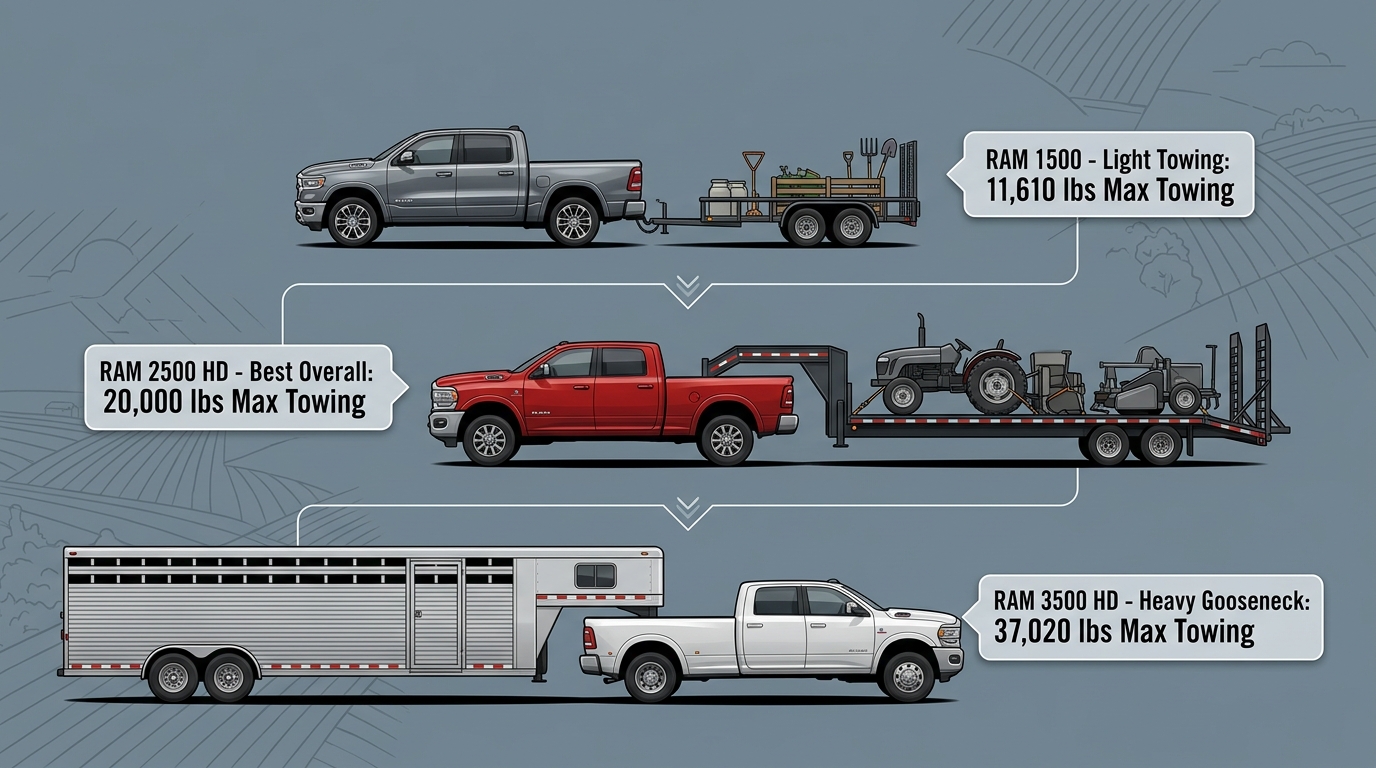
The 2027 Ram 2500 Heavy Duty equipped with the 6.7L Cummins Turbo Diesel is the best overall truck for agricultural towing on local farms, pulling up to 20,000 lb of equipment. For lighter implement transport, the 2027 Ram 1500 offers maximum towing up to 11,610 lb, while multi-ton gooseneck livestock or grain trailers require the 2027 Ram 3500 with its maximum towing capacity reaching 37,020 lb.
Matching the right pickup to your farm starts with evaluating fully loaded trailer weights rather than dry manufacturer estimates. Across the rolling farmland around Waynesboro, harvest demands require a chassis capable of carrying tongue weight, bed cargo, and rough field access roads without exceeding rear axle limits. Our team at Paul Thigpen CDJR Waynesboro helps farm managers evaluate gross combined weight ratings so your rig stays stable throughout the busiest harvest months.
If you are evaluating your vehicle requirements for the upcoming season, stop by our Waynesboro showroom address or give our sales specialists a quick call to review complete trailer specifications.
Table of Contents
- Which Ram Class Best Matches Light, Heavy, and Commercial-Scale Farm Towing?
- What Are the Heavy-Duty Towing, Payload, and Gooseneck Specs for Ram Pickups?
- How Does the 6.7L High Output Cummins Diesel Compare to Ford's Power Stroke Engine?
- How Should You Prepare a Ram Truck for Heavy Fall Harvest Towing Season?
- Are There Specialized Commercial Truck Dealers Serving Burke County Agriculture?
- Frequently Asked Questions About Fall Harvest Towing in Ram Trucks
Which Ram Class Best Matches Light, Heavy, and Commercial-Scale Farm Towing?
The Ram 1500 matches light-duty farm tasks such as utility hauling and smaller livestock transport, the Ram 2500 handles mid-sized equipment trailers and heavy bumper pulls, and the Ram 3500 is engineered for commercial gooseneck and fifth-wheel harvest loads.
Choosing the appropriate truck class prevents premature mechanical wear and keeps farm operations compliant with road weight limits. The 2027 Ram 1500 provides up to 11,610 lb of maximum towing when configured with the available 3.0L Hurricane twin-turbo engine, or up to 2,360 lb of payload with the 3.6L Pentastar V6, making it a practical daily vehicle for transporting tools, seed bags, and property maintenance implements. However, Ram specifically does not recommend using a 1500 chassis for gooseneck or fifth-wheel setups because pin weight can quickly exceed light-duty rear axle capacities.
Stepping up to the 2027 Ram 2500 delivers heavy-duty frame strength, offering maximum available gasoline towing of up to 17,740 lb and diesel towing reaching 20,000 lb. For agricultural operations pulling broad-acre grain carts or multi-horse trailers, the 2027 Ram 3500 provides the structural foundation needed for total stability under load. When configured as a dual-rear-wheel model with the 6.7L High Output Cummins Turbo Diesel, the Ram 3500 is rated to haul up to 37,020 lb via a gooseneck hitch.
Explore our current new Ram pickup inventory to compare payload tags across light-duty and heavy-duty models on our lot.
What Are the Heavy-Duty Towing, Payload, and Gooseneck Specs for Ram Pickups?
The 2027 Ram Heavy Duty lineup reaches up to 7,590 lb of maximum payload in gasoline Ram 3500 models and up to 37,020 lb of gooseneck towing capacity in diesel configurations.
Agricultural hauling requires balancing gross combination weight ratings with available bed payload. A 2027 Ram 3500 equipped with the 6.4L HEMI V8 gas engine offers a maximum payload capacity of up to 7,590 lb, providing substantial bed-carrying capability for liquid transfer tanks, seed totes, and bed-mounted toolboxes. In contrast, the diesel Ram 3500 offers a maximum payload of up to 6,460 lb because the iron-block Cummins engine adds curb weight over the front axle.
For gooseneck and fifth-wheel applications, Ram heavy-duty trucks can be optioned with the factory Fifth-Wheel/Gooseneck Prep Package, which integrates structural cross members directly into the truck bed floor. This system connects directly to the frame, ensuring safe load transfer when hauling equipment across the red clay dirt roads and pastures near Hephzibah.
Drivers comparing pre-owned heavy-duty trucks can also browse our pre-owned vehicle inventory for pre-equipped towing packages.
How Does the 6.7L High Output Cummins Diesel Compare to Ford's Power Stroke Engine?
The 6.7L High Output Cummins Turbo Diesel inline-six generates 1,075 lb-ft of torque lower in the engine speed range for heavy trailer launching, whereas Ford's 6.7L Power Stroke V8 relies on higher engine speeds to reach its peak horsepower ratings.
In agricultural applications, low-speed pulling power matters more than top-end speed on open highways. The inline-six architecture of the Cummins engine features fewer moving parts and larger connecting rod bearings than V8 diesel engines, contributing to thermal stability when pulling heavy equipment out of unpaved fields. Operating through the TorqueFlite HD eight-speed automatic transmission, the High-Output Cummins delivers its peak 1,075 lb-ft of torque at just 1,800 RPM.
Ford's 6.7L Power Stroke V8 produces higher peak output at 475 hp compared to 430 hp on the High-Output Cummins, but its V8 power curve requires higher RPMs to build pulling force. For heavy farm towing where steady low-end torque prevents wheel spin on soft soil, the inline-six Cummins design delivers continuous pulling force right off idle.
Inspect late-model diesel powertrains in our certified pre-owned Ram selection to evaluate work-ready diesel options.
How Should You Prepare a Ram Truck for Heavy Fall Harvest Towing Season?
Preparing a Ram truck for harvest towing requires setting cold tire pressures to match total axle ratings, inspecting engine coolant and transmission fluid, verifying trailer brake controller settings, and testing the Automatic Smart Exhaust Brake.
Autumn harvest work subjects truck drivelines to sustained high loads under warm ambient temperatures. Before attaching a loaded trailer, set rear tire cold pressures to the maximum inflation listed on the driver door jamb tag to prevent tire sidewall overheating. Inspect power steering, transmission, and cooling fluids for discoloration or low levels, as heavy towing generates significant thermal stress on torque converters and differential gears.
When setting up for fall harvest, experienced technicians always recommend testing the exhaust brake and integrated trailer brake controller under load before taking heavy grain wagons onto the highway. Verifying that safety chains cross under the coupler and that cargo is loaded low—with roughly 60% of total trailer weight positioned ahead of the trailer axles—helps prevent high-speed sway.
To prepare your current vehicle for trade or upgrade before harvest begins, you can value your trade-in online for an immediate vehicle valuation.
Are There Specialized Commercial Truck Dealers Serving Burke County Agriculture?
Paul Thigpen CDJR Waynesboro provides dedicated commercial vehicle support for regional agriculture, offering specialized sales guidance, heavy-duty service capabilities, and business financing programs.
Agricultural operations require rapid turnaround and heavy equipment expertise that standard automotive dealerships cannot provide. Our commercial truck team works directly with local farm managers, custom harvesters, and livestock haulers to configure chassis specs, rear axle ratios, and bed upfits for specific agricultural duties. We maintain priority service procedures to keep farm fleets operational during time-sensitive harvest cycles.
Our financial specialists can help structure business loans around farm cash-flow schedules; complete our online credit application to initiate pre-approval for your business.
Frequently Asked Questions About Fall Harvest Towing in Ram Trucks
Q: Can a Ram 1500 be fitted with a gooseneck hitch for farm work?
Ram does not recommend installing fifth-wheel or gooseneck hitches on the Ram 1500. Gooseneck trailers transfer high pin weights directly over the rear axle, which can exceed the maximum payload and rear axle weight ratings of a half-ton pickup. Farmers needing gooseneck capability should step up to a Ram 2500 or Ram 3500 chassis equipped with the factory prep package.
Q: Why does a diesel Ram 2500 have less available payload than a gas model?
The 6.7L Cummins Turbo Diesel engine weighs significantly more than the 6.4L HEMI V8 gas engine. Because maximum payload is calculated by subtracting the truck's unladen curb weight from its Gross Vehicle Weight Rating, the extra engine mass of the diesel reduces the remaining capacity available for bed cargo and trailer tongue weight.
Q: What maintenance is required for the Ram Automatic Smart Exhaust Brake?
The Automatic Smart Exhaust Brake uses variable turbine geometry within the turbocharger and does not require routine mechanical maintenance beyond standard engine servicing. Checking for exhaust system leaks and ensuring engine software stays updated during routine maintenance visits ensures the system continues providing consistent hill-descent engine braking.
Q: How does the available rear air suspension assist with trailer hitching?
The available Auto-Level Rear Air Suspension allows drivers to lower the rear bed height using controls inside the cab. This lowers the hitch ball or gooseneck pin below the trailer receiver, allowing smooth positioning without manually cranking trailer jack stands. Once hitched, the system automatically levels the chassis under load.
Q: What documents are needed when financing a commercial Ram farm truck?
When financing a farm truck under a business entity, buyers typically need to provide business registration documents, tax identification numbers, two years of agricultural business tax returns, and recent bank statements. Preparing these records in advance allows our finance department to process agricultural loan applications quickly.
Visit our dealership location, reach our team directly by calling (762) 365-0910, or use our online portal to order genuine OEM truck parts for seasonal maintenance.