



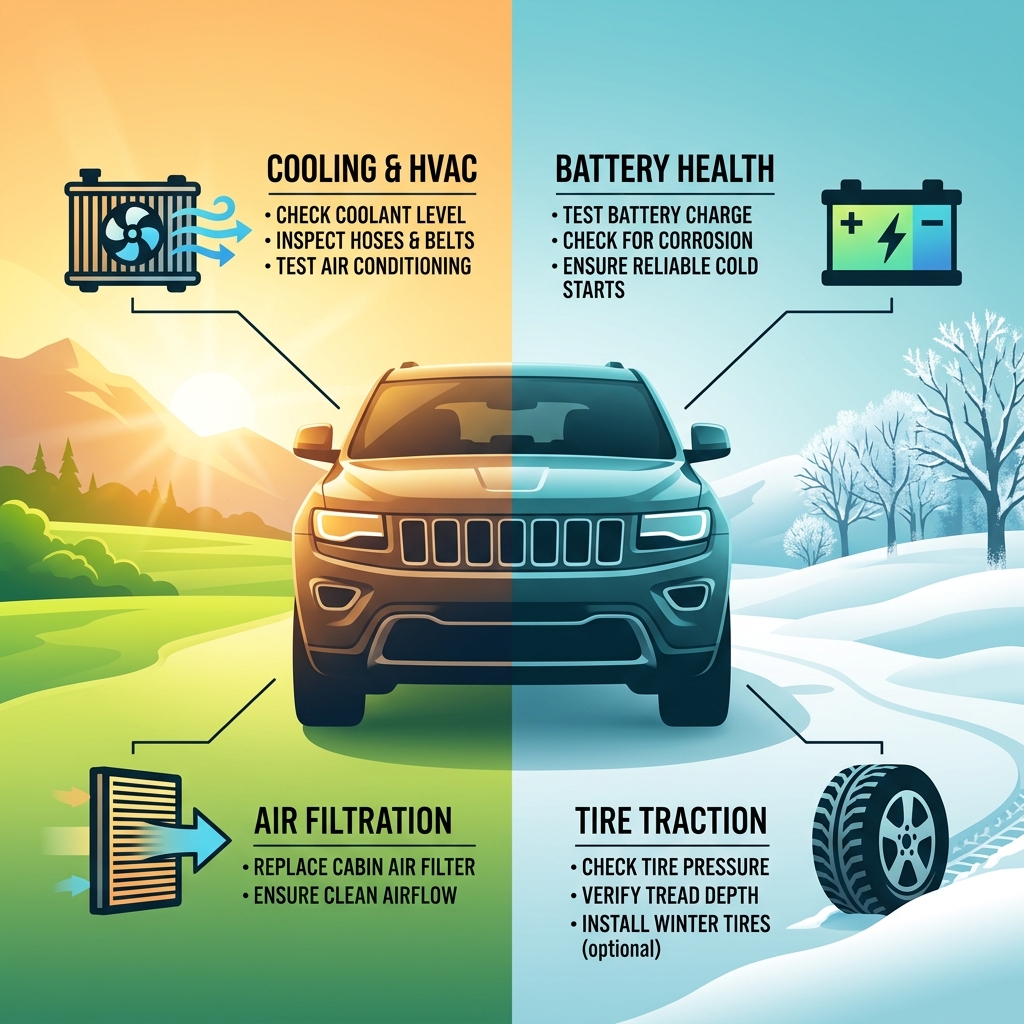
Seasonal maintenance for a Chrysler, Dodge, Jeep, or Ram vehicle requires updating fluid condition, tire traction, battery health, and HVAC operation to handle distinct weather swings. Spring and summer care prioritizes cooling system flushes, air conditioning performance, and cabin air filter replacements. Fall and winter service focuses on battery load testing, wiper blade replacement, and winter-rated washer fluid. Across all seasons, regular synthetic oil changes, tire rotations, and multi-point safety inspections maintain peak mechanical performance and long-term reliability.
Operating a vehicle through changing seasonal weather creates unique mechanical demands on major powertrain and chassis components. During hot summer months, engines operate under elevated ambient heat while air conditioning compressors run continuously. This environment accelerates engine oil thermal breakdown and increases thermal stress on radiator hoses, water pumps, and cooling fans. Conversely, winter weather drops ambient temperatures, which slows internal battery chemical reactions and reduces static tire pressure. Addressing these environmental shifts before peak weather hits prevents avoidable roadside mechanical failures.
Agricultural dust and unpaved back roads around Waynesboro place extra demands on air filtration and intake systems. Fine dirt particles and heavy spring pollen quickly clog engine air filters and cabin filters, reducing intake airflow efficiency and restricting climate control circulation. Performing comprehensive multi-point inspections during seasonal visits allows technicians to check fluid clarity, measure brake pad thickness, inspect steering linkage, and identify early suspension wear before small issues turn into major repairs.
Vehicle owners can easily manage routine ownership care by visiting our service department address for complete multi-point inspections and maintenance. To discuss specific service schedules or ask technical questions, give our team a quick call at (762) 365-0910. You can also secure a convenient appointment slot directly by scheduling a service appointment online today.
Table of Contents
- What Core Maintenance Services Keep Chrysler, Dodge, Jeep, and Ram Models Running Smoothly?
- Are Tire Rotations and Wheel Alignments Included in Seasonal Maintenance Packages?
- What Should You Inspect on a Chrysler Pacifica Before Summer Heat and Storms in Waynesboro?
- What Items Belong on a Chrysler Winter Maintenance Checklist?
- Why Choose Factory-Certified CDJR Technicians over a Generic Quick-Lube Shop?
- Common Questions About Chrysler Seasonal Maintenance
What Core Maintenance Services Keep Chrysler, Dodge, Jeep, and Ram Models Running Smoothly?
Core maintenance services for Chrysler, Dodge, Jeep, and Ram models consist of engine oil and filter replacements, tire rotations, brake system evaluations, and fluid checks performed every 5,000 to 7,500 miles. Following these foundational steps prevents premature wear on engine components, drivetrain differentials, and brake friction surfaces under daily driving demands.
Engine oil serves as the primary thermal barrier and lubricant within internal combustion engines. For popular Chrysler, Dodge, Jeep, and Ram powertrains equipped with the 3.6L Pentastar V6 engine, manufacturers specify high-grade 0W-20 full synthetic oil to maintain engine protection across broad operating temperatures. Vehicles powered by the larger 5.7L HEMI V8 engine utilize 5W-20 weight engine oil. Adhering to a 5,000 to 7,500-mile oil change schedule removes accumulated carbon deposits, combustion byproducts, and unburned fuel before oil viscosity degrades.
Routine driving habits like frequent short trips under 5 miles, extended engine idling, and heavy stop-and-go commuting fall under severe driving conditions. Under severe duty, engine oil degrades faster because internal crankcase temperatures do not stay warm long enough to burn off trapped moisture. Compressing maintenance intervals to roughly 5,000 miles preserves sensitive engine components, variable valve timing actuators, and hydraulic lifters.
Different models across the lineup demonstrate distinct care requirements:
- 2026 Chrysler Pacifica: Equipped with a 3.6L Pentastar V6 engine and 3,600-lb towing capacity, this family vehicle relies on clean engine oil and fresh cabin air filters to support its about 32 cubic feet of rear cargo volume during long road trips.
- 2026 Jeep Grand Cherokee: Featuring all-wheel drive capability and a 6,200-lb towing capacity, this SUV requires routine front and rear differential fluid inspections alongside transfer case checks to maintain off-road and towing durability.
- 2026 Ram 1500: Heavy payload demands and trailering generate higher operating temperatures in transmission and axle assemblies, requiring strict adherence to fluid maintenance schedules.
To keep every system performing to factory standards, our service center relies exclusively on authentic factory components. Vehicle owners seeking replacement air filters, brake pads, or wiper blades can keep their vehicle standard by ordering genuine Mopar parts directly through our department.
Are Tire Rotations and Wheel Alignments Included in Seasonal Maintenance Packages?
Tire rotations are routinely bundled into standard seasonal maintenance packages alongside oil changes, whereas wheel alignments are separate, specialized procedures performed when uneven tread wear or vehicle pulling is detected. Regular rotations every 5,000 to 7,500 miles ensure balanced tread wear, while alignments restore exact wheel angles to factory specifications.
During a tire rotation, technicians alter the position of each wheel on the vehicle using cross or front-to-rear movement patterns based on whether the vehicle uses front-wheel drive, rear-wheel drive, or four-wheel drive. Rotations counteract uneven rubber wear caused by weight distribution differences between the front engine bay and rear cargo area. Solid axle suspension designs on capable 4x4 models particularly benefit from regular rotations, which prevent severe cupping and edge wear along the tire perimeter.
Wheel alignments focus on adjusting suspension and steering geometry angles, specifically toe, camber, and caster. While a tire rotation changes where the tire sits on the hub, an alignment adjusts how the tire contacts the road surface. Hitting potholes, striking curb edges, or driving over rough surface gravel can knock suspension linkages out of alignment, causing the vehicle to pull to one side and rapidly scrubbing away rubber tread.
When vehicle owners ask our service advisors about seasonal packages during a check-in walk-around, they usually want to know if tire rotations are included with an oil change before asking about alignment service. Structured Mopar prepaid maintenance packages lock in routine services like oil changes, tire rotations, and safety inspections, protecting owners against future parts price adjustments while maintaining a complete, documented service history.
What Should You Inspect on a Chrysler Pacifica Before Summer Heat and Storms in Waynesboro?
Preparing a Chrysler Pacifica for summer heat and intense downpours requires inspecting the engine cooling system, testing air conditioning output, verifying 12-volt battery capacity, replacing the cabin air filter, and checking wiper blades. High ambient temperatures tax engine cooling components and battery chemical life, while sudden downpours require full tire tread depth and clear windshield visibility.
Summer cooling system inspections focus on coolant quality and system pressure integrity. Chrysler Pacifica engines utilize specialized Mopar Organic Additive Technology (OAT) 50/50 engine coolant pre-mixed with deionized water. Running low on coolant or using unapproved green silicate coolants causes internal gel formation and water pump failure. Performing a cooling system flush every 2 to 3 years or roughly 30,000 miles prevents scale buildup inside the radiator and engine block.
Air conditioning evaluations verify system pressure and refrigerant charge levels for systems using R134a or R1234yf refrigerants. Sluggish or lukewarm vent cooling signals low refrigerant charge or restricted airflow across the condenser. Replacing the cabin air filter before summer removes trapped pollen, leaves, and road dust, restoring full airflow through the HVAC evaporator core.
Hot summer pavement significantly increases tire inflation pressure. Checking tire pressure when tires are cool prevents over-inflation, which reduces the contact patch during heavy summer rainstorms. Combining correct tire pressure with at least 4/32-inch tread depth prevents hydroplaning on water-covered highways. Finally, replacing worn windshield wiper blades every 6 to 12 months ensures clean glass wiping during sudden tropical downpours.
What Items Belong on a Chrysler Winter Maintenance Checklist?
A comprehensive winter maintenance checklist for Chrysler, Dodge, Jeep, and Ram vehicles focuses on testing battery voltage, checking engine coolant freezing points, inspecting tire tread depth and inflation pressure, replacing worn wiper blades, and verifying exterior lighting. Freezing temperatures reduce battery output capacity while demanding higher electrical current for cabin heaters and defrosters.
Automotive 12-volt batteries lose roughly 35 percent of their cranking strength when temperatures drop to freezing. Older batteries aged 3 to 5 years that function adequately during mild weather often fail suddenly during cold snaps. Performing a professional battery load test measures cold cranking amps and identifies internal cell degradation before a starting failure leaves drivers stranded.
Tire management becomes critical as temperatures decline. Ambient air pressure drops approximately 1 psi for every 10-degree decrease in outside temperature, leading to under-inflated tires during sudden cold weather. Ensuring proper cold inflation pressure maintains tire sidewall stability and maximizes tread grip on icy or slushy road surfaces.
Early morning commutes along rural routes near Hephzibah frequently encounter sudden temperature drops and damp pavement, making cold-weather battery testing and tire traction checks essential before winter arrives.
Essential items for a complete winter maintenance checklist include:
- Battery and Charging System: Load-test battery capacity, clean terminal corrosion, and confirm alternator charging voltage output.
- Coolant and Antifreeze: Verify freeze protection levels down to sub-zero temperatures using a hydrometer.
- Windshield Wipers and Washers: Install winter-rated wiper blades and fill fluid reservoirs with washer fluid rated for freezing conditions.
- Tire Pressure and Tread: Adjust inflation pressures for cold weather and confirm tread depth exceeds minimum traction thresholds.
- Emergency Supplies: Pack jumper cables, a flashlight, an ice scraper, a warm blanket, and a portable phone power bank.
Why Choose Factory-Certified CDJR Technicians over a Generic Quick-Lube Shop?
Factory-certified CDJR technicians possess specialized Mopar factory training, utilize advanced diagnostic software tailored to Chrysler, Dodge, Jeep, and Ram vehicles, and install original equipment parts backed by warranty. Generic quick-lube outlets frequently rely on universal fluids and non-OEM filters that may fail to meet manufacturer specifications.
Modern powertrains feature complex electronic controls, sophisticated emissions equipment, and specialized fluid requirements. For example, servicing a modern TorqueFlite 8-speed automatic transmission or heavy-duty rear differential requires exact fluid temperature monitoring during fill procedures using specialized diagnostic tools. Generic lube shops lack proprietary diagnostic equipment, increasing the risk of over-filling or under-filling sealed transmission assemblies.
Engine management systems utilize intelligent oil-life monitoring algorithms that calculate oil degradation based on engine revolutions, ambient temperatures, idle time, and load factor. Certified technicians reset and calibrate these diagnostic tracking systems correctly during service visits while checking module software for factory technical service bulletins and open safety recalls.
Choosing certified service ensures that every replacement part—from oil filters with exact bypass valve pressures to model-specific brake pads—meets original factory standards. All installed Mopar original equipment parts carry factory warranty backing, preserving vehicle resale value and maintaining comprehensive coverage under original manufacturer warranty guidelines.
Common Questions About Chrysler Seasonal Maintenance
Q: How often should the cabin air filter be replaced on a Chrysler vehicle?
Replacing the cabin air filter is recommended every 15,000 to 30,000 miles or at least once per year. In regions with heavy spring pollen or dusty dirt roads, replacing the filter at the start of spring prevents restricted HVAC airflow and maintains interior air quality.
Q: How does an intelligent oil-life monitoring system calculate service intervals?
The intelligent oil-life monitoring system evaluates operating conditions including cold engine starts, continuous engine idling time, ambient operating temperatures, and vehicle load. Instead of simply counting mileage, the system calculates actual oil breakdown and alerts the driver when an oil change is needed.
Q: What driving conditions qualify as severe duty for CDJR service schedules?
Severe driving conditions include making frequent short trips under 5 miles, driving in heavy stop-and-go traffic, towing heavy trailers, sustained idling, or driving on unpaved gravel roads. Under severe duty conditions, maintenance intervals for oil, filters, and fluid checks should be shortened by roughly 40 to 50 percent.
Q: Why is Mopar OAT coolant required for modern Chrysler engine cooling systems?
Modern Chrysler engines require Mopar Organic Additive Technology (OAT) coolant because it provides long-life corrosion protection for aluminum engine blocks and radiator cores. Mixing conventional silicate coolant with OAT coolant causes fluid gelling, restricted coolant passages, and catastrophic engine overheating.
Q: How can owners schedule seasonal maintenance or contact the service center?
Vehicle owners can easily schedule seasonal maintenance online or visit our dealership location for complete certified service. To speak directly with a service advisor regarding maintenance schedules or vehicle care, give our service team a call at (762) 365-0910 today.
© 2026 Paul Thigpen CDJR Waynesboro. All rights reserved.