




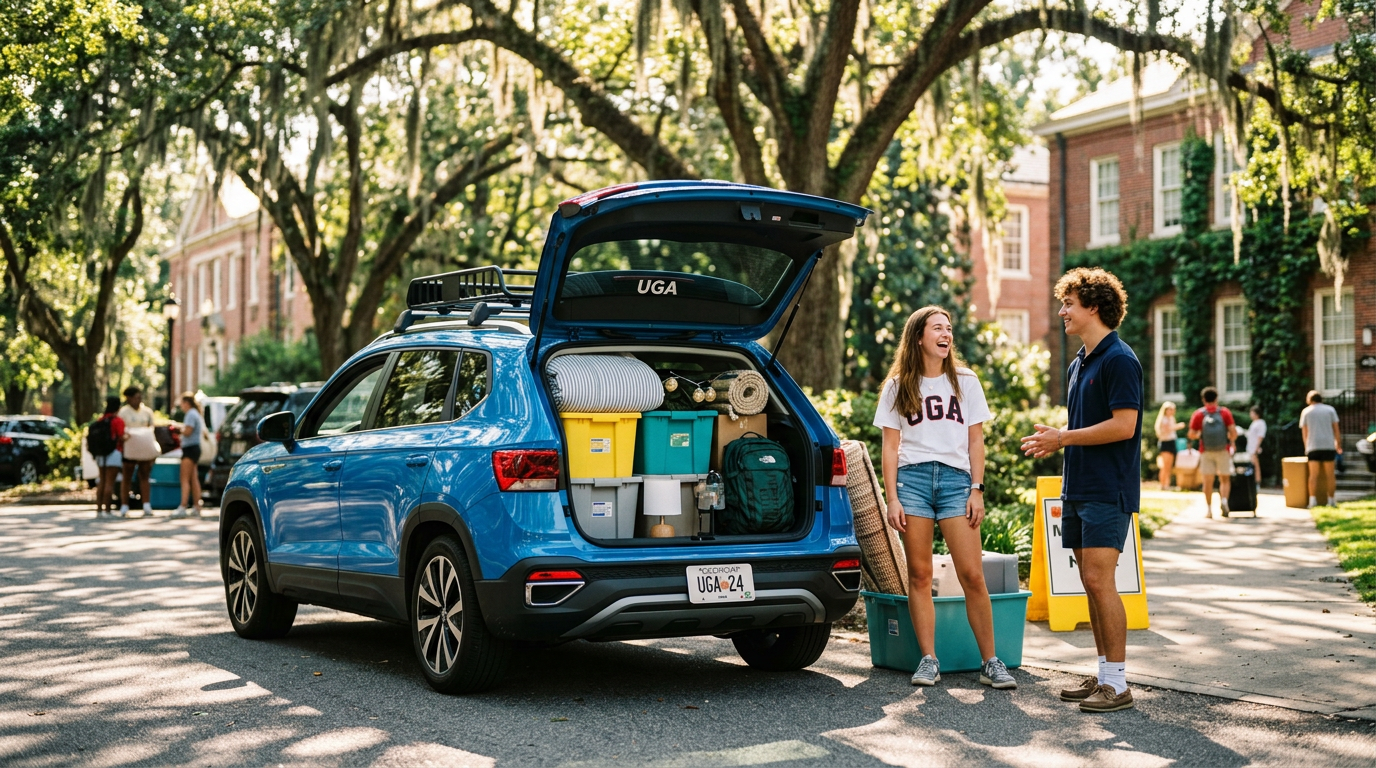
Heading off to college is a major milestone, but a highway breakdown on the way to campus can quickly derail that excitement. For students making the trip from the local area to Statesboro, ensuring your vehicle is mechanically prepared is the single best way to prevent unexpected disruptions to your academic schedule. Long highway stretches, heavy traffic, and the daily demands of campus commuting require a vehicle that is operating at peak efficiency.
Before loading up the trunk with dorm supplies, scheduling a comprehensive maintenance check is highly recommended. Our certified service team specializes in preparing passenger vehicles for long-distance reliability and sustained performance. Whether you are driving a rugged Jeep SUV or a fuel-efficient compact car, a proactive inspection helps identify hidden mechanical issues before they develop into costly roadside emergencies.
If you are finalizing your departure checklist, you can reach our service department directly by giving us a quick call to discuss any specific performance concerns. If you would prefer to consult with our technicians in person or drop off your vehicle for a professional diagnostic check, you can easily map out your visit to our service center by getting our exact showroom and service address before hitting the road. Taking this simple step ensures your vehicle is fully prepared to handle the academic year ahead.
Table of Contents
- The Ultimate DIY Pre-Trip Inspection Checklist vs. Professional Diagnostics
- Essential Fluids to Monitor Before Commuting to Campus
- How Georgia Heat Affects Your Battery and Signs of Early Failure
- Managing Battery Drain During Two-Week Campus Parking Breaks
- Choosing the Right Jumper Cables and Emergency Gear for Roadside Prep
- Common Questions About Student Vehicle Maintenance and Service Costs
- Schedule Your Pre-Semester Service at Paul Thigpen CDJR Waynesboro
The Ultimate DIY Pre-Trip Inspection Checklist vs. Professional Diagnostics
Many students ask if they can perform a pre-trip vehicle inspection themselves to save money before heading to campus. The answer is yes, you can easily manage several basic visual checks at home without specialized tools. A thorough DIY inspection is an excellent way to maintain situational awareness of your vehicle's general condition and keep ownership costs manageable.
To conduct a basic home inspection, start with a thorough walk-around of the vehicle. Verify that all exterior lighting functions correctly, including the high beams, hazard lights, turn signals, and brake lights. Check the condition of your windshield wiper blades; if they leave streaks or have torn rubber, they should be replaced immediately. Next, check your tire pressure using a digital gauge, comparing the reading against the recommended PSI listed on the driver-side door jamb placard. Be sure to inspect the tire treads for uneven wear patterns, embedded debris, or sidewall bulging, and verify that your spare tire is properly inflated.
While a DIY check is highly effective for surface-level items, certain critical systems require specialized diagnostic equipment and professional expertise. Components such as brake pad thickness, rotor condition, suspension bushings, steering linkages, and onboard computer codes cannot be thoroughly evaluated in a driveway. A certified technician can hoist the vehicle on a lift to inspect the undercarriage for fluid leaks, exhaust system damage, and CV boot tears that are invisible from above.
To ensure your vehicle is completely safe for high-speed highway driving, you can easily schedule a service appointment online for a professional multi-point inspection. If your home inspection reveals worn-out wiper blades, a weak cabin air filter, or other minor wear items, you can order genuine OEM parts directly through our department to guarantee a precise fit and reliable performance.
Essential Fluids to Monitor Before Commuting to Campus
What are the most essential car fluids to check before driving to Georgia Southern University? To keep your engine operating safely under high thermal loads, you must regularly monitor five primary fluids: engine oil, coolant, brake fluid, windshield washer fluid, and power steering fluid. Neglecting these basic fluids can lead to severe mechanical failures, including engine seizure, overheating, or a dangerous loss of braking pressure.
Engine oil is the lifeblood of your powertrain, lubricating moving parts and dispersing heat. Pull the dipstick, wipe it clean, reinsert it, and pull it again to verify the level sits between the minimum and maximum indicator marks. The oil should be a translucent amber color; if it is dark black or gritty, it is time for a change. For a typical college student's commuter car, conventional oil should be replaced every 5,000 miles, while full synthetic oil can safely last between 10,000 and 15,000 miles depending on the manufacturer guidelines.
Coolant is equally critical, especially when navigating the humid climate of Augusta where stop-and-go traffic can rapidly elevate engine temperatures. Check the translucent plastic coolant overflow reservoir to ensure the fluid level is resting comfortably between the low and high markings. Never open a hot radiator cap, as pressurized steam can cause severe burns. If you notice a rising temperature gauge on your dashboard, sweet-smelling steam drifting from under the hood, or a visible puddle of bright green, orange, or pink fluid beneath your engine bay, your coolant level is likely low or leaking.
Brake fluid operates within a sealed hydraulic system, and a drop in fluid level typically points to worn brake pads or a physical leak in the brake lines. Low brake fluid reduces hydraulic pressure, resulting in a soft or spongy brake pedal and significantly increased stopping distances. Finally, ensure your windshield washer reservoir is topped off with a high-quality fluid to maintain clear visibility through dust, pollen, and sudden afternoon downpours.
How Georgia Heat Affects Your Battery and Signs of Early Failure
Extreme seasonal heat is actually far more damaging to a car battery than freezing winter temperatures. High under-hood temperatures accelerate internal structural corrosion and cause the liquid electrolyte solution inside a flooded lead-acid battery to evaporate prematurely. This chemical degradation permanently reduces the battery's capacity and weakens its ability to deliver sufficient cranking amps when starting the engine.
Recognizing the early warning signs of a failing battery can save you from being stranded in a parking lot. The most common indicator is a slow or sluggish engine crank when you turn the key or push the start button. You may also notice your headlights and cabin lights dimming significantly when the engine is idling, or hear a rapid clicking sound from the starter motor when attempting to start the vehicle.
If the battery case itself appears swollen, bloated, or is venting a harsh, sulfur-like odor resembling rotten eggs, it has likely been damaged by excessive heat or overcharging. A dashboard warning light shaped like a battery is another clear signal that your charging system is not operating within its designated voltage parameters. On average, a standard automotive battery in the South has a reliable lifespan of roughly 3 to 5 years before requiring replacement.
Managing Battery Drain During Two-Week Campus Parking Breaks
A common concern for students living in campus dormitories is whether a car battery will drain if the vehicle remains parked and unused for two weeks. The answer is yes; modern vehicles are equipped with continuous electrical draws known as parasitic loads. Onboard computers, security systems, remote keyless entry receivers, and digital clocks constantly draw a tiny amount of electrical current from the battery even when the ignition is completely turned off.
If a battery is already weak or nearing the end of its functional lifespan, these persistent parasitic draws can easily deplete its remaining charge within 10 to 14 days of total inactivity. This issue is particularly common during mid-semester breaks or finals week when students spend consecutive days studying without driving. To prevent a dead battery, it is highly recommended to start your vehicle and drive it at highway speeds for at least 20 to 30 minutes once a week. This allows the alternator sufficient time to replenish the lost charge.
For students who live in rural residential areas like Hephzibah and commute to campus, these longer driving distances naturally keep the battery fully charged. However, if your vehicle must remain parked for an extended period, ensure all interior dome lights, map lights, and auxiliary chargers plugged into 12-volt ports are completely turned off. If you suspect your battery is struggling to hold a charge, having our service team perform a digital load test before the semester begins will provide peace of mind.
Choosing the Right Jumper Cables and Emergency Gear for Roadside Prep
Every student vehicle should be equipped with a dedicated roadside emergency kit. The cornerstone of this kit is a high-quality set of jumper cables. When selecting cables, look for heavy-duty 4-gauge or 6-gauge copper-clad aluminum cables that are at least 12 to 20 feet in length. Thicker, lower-gauge wires carry electrical current much more efficiently, and longer cables ensure you can easily connect two vehicles even if you cannot park them nose-to-nose on a crowded campus street.
In addition to jumper cables, your roadside kit should contain several essential safety items:
- A highly visible reflective warning triangle or emergency flares
- A bright LED flashlight with extra batteries
- A basic tire pressure gauge and a portable 12-volt tire inflator
- A pair of heavy-duty work gloves and a basic tool kit
- Non-perishable bottled water and a first-aid kit
If you experience a flat tire, dead battery, or mechanical breakdown on the highway, having a manufacturer-backed safety net is invaluable. Vehicles covered under a Chrysler, Dodge, Ram, or Jeep warranty have access to dedicated roadside assistance programs. These programs provide manufacturer-certified towing, flat tire service, emergency fuel delivery, and battery jump-starts using brand-specific expertise and authorized service networks.
For immediate assistance on the road, you can contact Chrysler, Dodge, Ram, Jeep Roadside Assistance: 800-521-2779 to coordinate professional, warranty-protected support. Our service department works closely with these roadside programs to ensure that if your vehicle requires towing, it is brought directly to our facility where certified technicians can install genuine OEM parts and restore your vehicle to factory specifications.
Common Questions About Student Vehicle Maintenance and Service Costs
Q: Which compact cars have the lowest overall annual maintenance costs?
A: Highly popular Japanese compact models like the Toyota Corolla and Honda Civic consistently rank among the most affordable vehicles to maintain over time, with average annual routine service and repair costs hovering under $400. In the entry-level luxury space, the 2021 Acura ILX is recognized for its low cost of ownership, featuring a reliable 201-horsepower 2.4-liter engine paired with an 8-speed dual-clutch automatic transmission that delivers an EPA-estimated 24 mpg city / 34 mpg highway.
Q: Is it safe to mix different colors of windshield washer fluid?
A: Yes, mixing different colors of washer fluid is generally safe and will not damage your vehicle's washer pump or lines. However, if you mix a specialized winter de-icing formula with a standard summer bug-wash formula, you will dilute the chemical concentration, which lowers the overall freeze-resistance of the fluid during colder weather.
Q: How often should engine oil be changed for a college student's commuter car?
A: The exact interval depends entirely on the type of oil your vehicle requires. Conventional engine oil typically needs to be changed every 3,000 to 5,000 miles. If your vehicle utilizes full synthetic oil, the interval is significantly longer, generally ranging from 10,000 to 15,000 miles or once every 12 months, whichever comes first.
Q: Can low brake fluid cause a car to fail inspection or stop poorly?
A: Yes, low brake fluid directly compromises the safety of your braking system. Because brakes rely on hydraulic pressure to press the pads against the rotors, any drop in fluid level or introduction of air bubbles into the lines will result in a soft, spongy brake pedal, reduced stopping power, and potentially complete brake failure.
Schedule Your Pre-Semester Service at Paul Thigpen CDJR Waynesboro
Keeping your vehicle in top mechanical condition is the best way to ensure a successful, stress-free semester. From battery testing and tire rotations to oil changes and brake inspections, our factory-trained technicians are here to help you stay safe on the road.
Do not wait for a dashboard warning light to disrupt your busy class schedule. Contact our service team today by calling (762) 365-0910 to speak with an advisor, or find us easily by checking our dealership directions to plan your visit before you make the drive back to school.