




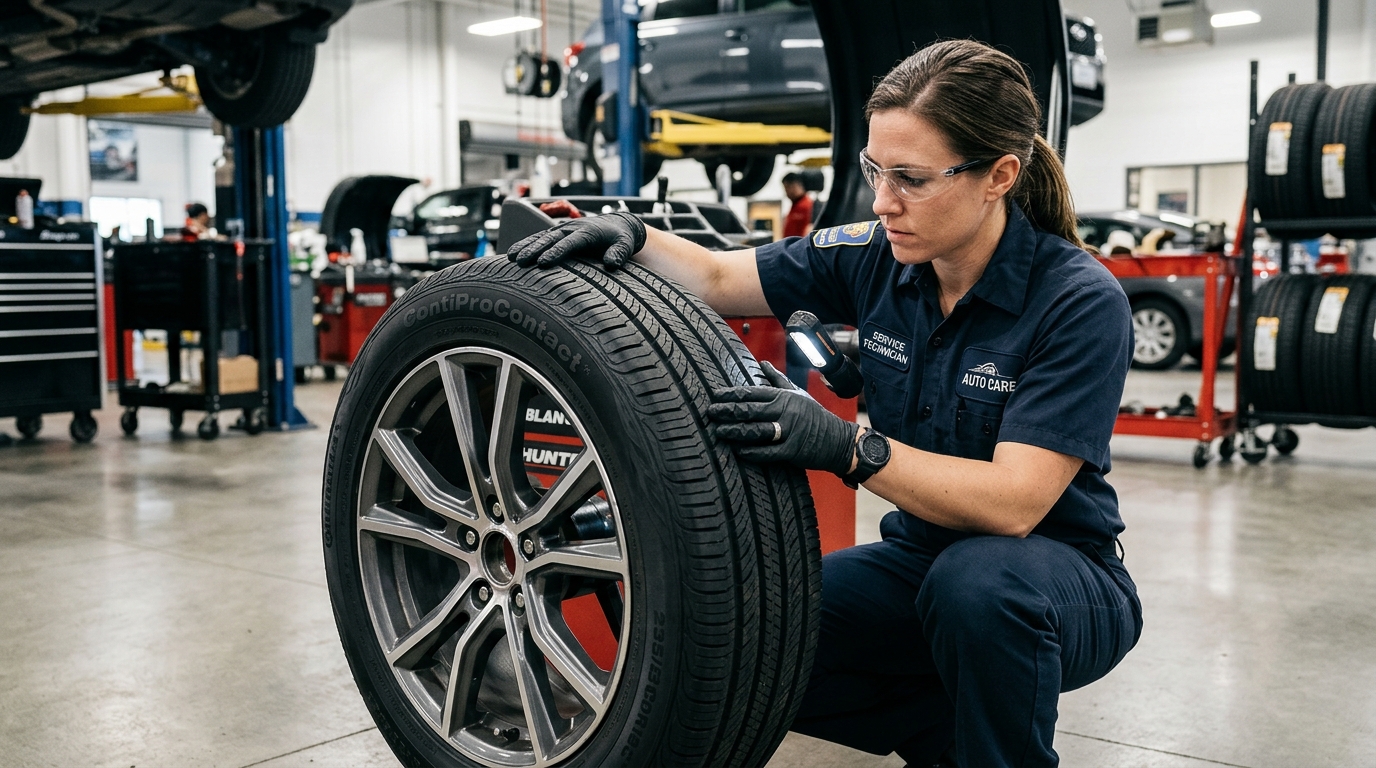
Drivers can get comprehensive tire service in Waynesboro at professional dealership service centers, local tire shops, and retail auto care facilities. Our service department provides complete tire maintenance, including precision mounting, digital balancing, wheel alignments, and factory-recommended replacement tires tailored to Chrysler, Dodge, Ram, and Jeep models.
Selecting the right location for tire care depends on your vehicle's technical needs and your overall maintenance schedule. A dealership service department combines specialized tire installation with factory-trained technicians who understand specific drivetrain requirements, suspension setups, and tire pressure monitoring systems. When replacing tires, our team verifies that every tire matches the vehicle manufacturer's load index and speed ratings to ensure original ride quality and safety standards.
In addition to installing new rubber, routine maintenance visits offer an opportunity to evaluate your complete wheel assembly. Professional tire services include inspecting wear patterns, adjusting cold inflation pressure, rotating tires to equalize tread wear, and performing four-wheel alignments. Setting up an appointment with our Waynesboro service center location gives you access to complete tire care backed by original equipment manufacturer standards. For immediate assistance or fitment advice, you can reach our service team directly by giving us a quick call at (762) 365-0910.
Table of Contents
- What Is the Minimum Legal Tire Tread Depth and How Is It Measured?
- How Much Does a New Set of Tires and Installation Cost on Average?
- Where Is the Tire Size Code Located on Your Vehicle?
- Do All-Weather Tires Carry the Three-Peak Mountain Snowflake Symbol?
- Where to Buy Tires: Local Shops, Retailers, and Service Centers
- How Do You Schedule a Tire Installation Appointment?
- Frequently Asked Questions About Tire Care and Replacement
- Keep Your Vehicle Riding Safely with Professional Tire Care
What Is the Minimum Legal Tire Tread Depth and How Is It Measured?
The minimum legal tire tread depth in most states is 2/32 inch measured across the primary tread grooves. Driving on tires worn to or below this minimum threshold drastically reduces traction, increases braking distances, and heightens the risk of hydroplaning on wet roads.
Tread depth is measured using three common methods: a calibrated tread depth gauge, built-in treadwear indicator bars, or a simple coin test. Tire manufacturers mold narrow rubber bars across the bottom of the tread grooves that sit flush with the tread surface when wear reaches exactly 2/32 inch. To check your tires manually without a gauge, place a standard Lincoln penny upside down into several outer and inner grooves across the tire surface. If the top of Lincoln's head remains visible at any point, the tread depth has dropped below 2/32 inch, indicating that the tire must be replaced immediately.
+------------------------+-------------------------------+-----------------------------------+
| Tread Depth            | Condition Status              | Driving Implication               |
+------------------------+-------------------------------+-----------------------------------+
| 10/32 inch to 12/32 in | New Tread                     | Optimal traction and water removal|
| 5/32 inch to 6/32 inch | Moderate Wear                 | Good traction; monitor regularly  |
| 4/32 inch              | Rain Warning Threshold        | Increased hydroplaning risk       |
| 2/32 inch              | Minimum Legal Limit           | Replacement required immediately  |
+------------------------+-------------------------------+-----------------------------------+
While 2/32 inch marks the absolute legal boundary, tires lose significant wet-weather capability well before reaching that line. Tread channels are engineered to pump water out from under the contact patch, and reduced groove depth severely restricts water evacuation at highway speeds. Furthermore, uneven tread wear—such as feathering on outer edges or severe center wear—signals underlying mechanical issues. Worn suspension bushings, incorrect wheel alignment, or improper inflation pressure can ruin new tread prematurely. When inspecting your tires, our team can help you check wear patterns and order OEM replacement tires and service parts online to protect your vehicle's road contact.
How Much Does a New Set of Tires and Installation Cost on Average?
A standard set of four passenger car tires costs between $400 and $800, while tires for light trucks, full-size SUVs, or commercial vehicles range from $800 to $1,800. Mounting and balancing services add between $15 and $45 per tire to the overall invoice, depending on wheel diameter, rim material, and tire pressure sensor service needs.
The total price of replacement tires varies based on key engineering specifications, including section width, overall diameter, compound formulation, and performance categorization. Premium all-weather tires or heavy-duty all-terrain options designed for high load capacities cost more upfront due to reinforced sidewalls and advanced rubber compounds. Conversely, basic highway-terrain or touring tires provide an economical option for daily commuting.
+-----------------------------------+-----------------------+----------------------------------+
| Vehicle Category                  | Estimated Set Price   | Average Per-Tire Installation    |
+-----------------------------------+-----------------------+----------------------------------+
| Sedan / Hatchback Touring         | $400 - $800           | $15 - $30                        |
| Crossover / Medium SUV All-Season | $600 - $1,100         | $20 - $35                        |
| Full-Size Truck / Off-Road SUV    | $800 - $1,800         | $25 - $45                        |
+-----------------------------------+-----------------------+----------------------------------+
Professional installation cost includes several technical steps beyond sliding the rubber onto the wheel. Technicians demount the old tire, install a new valve stem or rebuild the Tire Pressure Monitoring System (TPMS) seal kit, mount the new tire, and perform dynamic high-speed balancing. Dynamic balancing attaches calibrated counterweights to the wheel rim to neutralize heavy spots, preventing steering wheel vibration and uneven tread wear. When budgeting for replacement tires, factor in additional routine services like a four-wheel alignment to protect your financial investment.
Where Is the Tire Size Code Located on Your Vehicle?
The recommended tire size code is printed on the vehicle manufacturer's tire information placard, permanently attached to the driver-side door jamb. The complete dimensional sequence is also stamped into the outer sidewall of your current tires and listed inside the owner's manual.
                       P 225 / 65 R 17  102 H
|  |    |  |  |   |   |
Tire Type (Passenger)+  |    |  |  |   |   +-- Speed Rating (H = 130 mph)
Section Width (mm)---+    |  |  |   +------ Load Index (102 = 1,874 lbs)
Aspect Ratio (%)------+  |  +---------- Rim Diameter (Inches)
Internal Construction---+ (Radial)
Reading the standardized code allows you to identify exact fitment parameters required for safety and speedometer calibration:
- Service Type: The leading letter identifies intended vehicle class, such as "P" for passenger vehicles or "LT" for light trucks.
- Section Width: A three-digit number representing the tire width in millimeters from sidewall to sidewall (e.g., 225).
- Aspect Ratio: A two-digit number expressing sidewall height as a percentage of section width (e.g., 65 means height is 65% of width).
- Internal Construction: The letter "R" designates radial construction, where internal ply cords run perpendicular to the direction of travel.
- Rim Diameter: A two-digit number indicating wheel diameter in inches (e.g., 17).
- Load Index and Speed Rating: A numerical value specifying maximum load-carrying capability paired with a letter symbol designating maximum sustained operating speed (e.g., 102H).
Relying on the door-jamb placard ensures you select replacement tires that maintain original vehicle engineering standards. Crucially, use the placard's specified cold inflation pressure figures to set tire pressure, rather than the maximum pressure stamped on the tire sidewall. The sidewall figure represents the maximum threshold the tire can safely hold at maximum load, whereas the door jamb figure provides the ideal pressure calculated by chassis engineers for balanced ride, fuel economy, and tire longevity.
Do All-Weather Tires Carry the Three-Peak Mountain Snowflake Symbol?
All-weather tires carry the Three-Peak Mountain Snowflake (3PMSF) symbol stamped directly on their sidewalls. This icon depicts a snowflake enclosed within a three-peaked mountain outline, certifying that the tire meets standardized severe snow traction testing protocols.
       /\
/  \       +-----------------------------------------------------------+
/ /\ \      |  THREE-PEAK MOUNTAIN SNOWFLAKE (3PMSF) CERTIFICATION      |
/ /  \ \     |  - Tests minimum peak acceleration traction on snow       |
/ / /\ \ \    |  - Outperforms standard M+S ratings by at least 10%       |
/_/_/__\_\_\   |  - Uses specialized low-temperature rubber polymers       |
+-----------------------------------------------------------+
Drivers often confuse standard all-season tires with true all-weather tires. Standard all-season tires utilize rubber compounds engineered for moderate summer heat and dry roads, but their compounds harden when ambient temperatures drop below 45 degrees Fahrenheit, reducing grip. All-season tires typically carry only an "M+S" (Mud and Snow) geometry designation based on open tread ratio rather than physical cold-weather traction testing.
In contrast, all-weather tires combine high-density siping and silica-rich tread compounds that remain pliable in below-freezing temperatures while maintaining durability on warm summer asphalt. To earn the 3PMSF rating, an all-weather tire must demonstrate at least 10% greater acceleration traction on packed snow than a standardized reference tire. This qualification provides confidence for year-round driving across changing seasonal weather without requiring semi-annual swaps between dedicated summer and winter tires.
Where to Buy Tires: Local Shops, Retailers, and Service Centers
Selecting where to buy tires involves evaluating inventory options, mounting expertise, and ongoing maintenance support. Vehicle owners can purchase tires from dedicated brand service departments, independent tire repair centers, or regional retail auto centers.
+----------------------------+-----------------------------------+-----------------------------------+
| Facility Type              | Primary Advantages                | Ideal Service Scenario            |
+----------------------------+-----------------------------------+-----------------------------------+
| Dealership Service Center  | OEM-matched specs, factory tech   | Integrated maintenance & warranty |
| Independent Tire Shop      | Local service, varied brands      | Custom wheels, quick repairs      |
| Retail Supercenter         | Extended hours, bulk inventory    | Budget shopping, basic fitting    |
+----------------------------+-----------------------------------+-----------------------------------+
Our service advisors regularly assist owners who operate vehicles under demanding local driving conditions. For example, truck owners navigating agricultural property and unpaved county access roads near Waynesboro require durable tread patterns with high load capacities to prevent punctures. Meanwhile, commuters traveling rural highway stretches around Hephzibah benefit from touring tires designed to handle red clay runoff while minimizing cabin road noise.
Choosing a dealership service center ensures your replacement tires are verified directly against vehicle manufacturer requirements. Dealership technicians use specialized equipment that protects aluminum alloy wheels from rim damage during demounting, calibrate electronic drive-assist systems tied to wheel rotation speeds, and reset TPMS sensors correctly. Additionally, purchasing tires through a dealership allows you to bundle installation with routine oil changes, brake inspections, or recall updates in a single efficient visit.
How Do You Schedule a Tire Installation Appointment?
You can schedule a tire installation appointment online through a service scheduling portal, by contacting the service desk over the phone, or by consulting a service advisor in person.
Booking an appointment in advance guarantees that your exact tire size, load index, and tread model are pulled from inventory and staged in the service bay prior to your arrival. When preparing to schedule, have your vehicle's year, make, model, and tire size code ready. If you are unsure of your tire sizing, a quick review of the driver-side door jamb placard will provide the exact specifications required by our service team.
To book your visit with our team, request an appointment through our service center address or arrange your installation by calling (762) 365-0910. During your installation visit, our factory-certified technicians will mount and balance your new tires, check wheel alignment specs, inspect brake pad thickness, and reset your vehicle's tire pressure monitoring system.
Frequently Asked Questions About Tire Care and Replacement
Q: Does driving on tread at the 2/32-inch legal minimum increase hydroplaning risk?
Driving on tires worn down to 2/32 inch severely increases hydroplaning risk on wet roads. Tread grooves act as channels that channel standing water away from the contact patch. When groove depth is reduced to 2/32 inch, water cannot escape fast enough, causing the tire to ride on a thin film of water and lose total steering control. Replacing tires before they reach this threshold maintains critical wet-weather safety.
Q: Should replacement tire pressure match the sidewall PSI number?
Replacement tire inflation pressure should always match the cold pressure number printed on your vehicle's door-jamb placard, never the maximum PSI stamped on the tire sidewall. The sidewall maximum represents the upper safety limit of the tire structure under full load. The vehicle placard figure is optimized by chassis engineers to ensure proper handling, braking performance, tire wear, and fuel efficiency.
Q: How often should tires be rotated to ensure even tread wear?
Tires should be rotated every 5,000 to 7,500 miles, or alongside every routine oil change service. Front and rear tires perform different work; front tires handle steering forces and carry more engine weight, while rear tires roll straight. Regular rotation shifts tires to different wheel positions, equalizing wear patterns and extending overall tread lifespan across all four wheels.
Q: Can an alignment issue cause new tires to wear down prematurely?
Improper wheel alignment rapidly destroys new tire tread by scrubbing the rubber sideways against the pavement. Incorrect camber or toe settings create uneven wear across the inner or outer tread edges, ruining a new set of tires within a few thousand miles. Scheduling a four-wheel alignment check during tire installation protects your investment and maintains straight-line tracking.
Q: What vehicle information should you have ready when requesting a tire quote?
When requesting a tire quote, have your vehicle's year, make, model, trim, and current tire size code available. The size code—located on the driver-side door jamb placard—ensures the quoted tires meet exact width, aspect ratio, rim diameter, load index, and speed rating specifications established by the manufacturer.
Keep Your Vehicle Riding Safely with Professional Tire Care
Proper tire selection, correct inflation pressure, and routine rotation schedules are essential for preserving vehicle safety, passenger comfort, and overall fuel efficiency. Monitoring tread depth regularly protects against unexpected air loss, hydroplaning, and extended stopping distances in adverse weather. When replacement becomes necessary, choosing factory-matched tires engineered for your specific vehicle ensures optimal handling performance.
Our factory-trained technicians at Paul Thigpen CDJR Waynesboro are ready to inspect your tread wear, perform wheel alignments, and install OEM-recommended replacement tires. Connect with our service department today by calling (762) 365-0910 or visit our Waynesboro facility to schedule your tire inspection and installation appointment.