




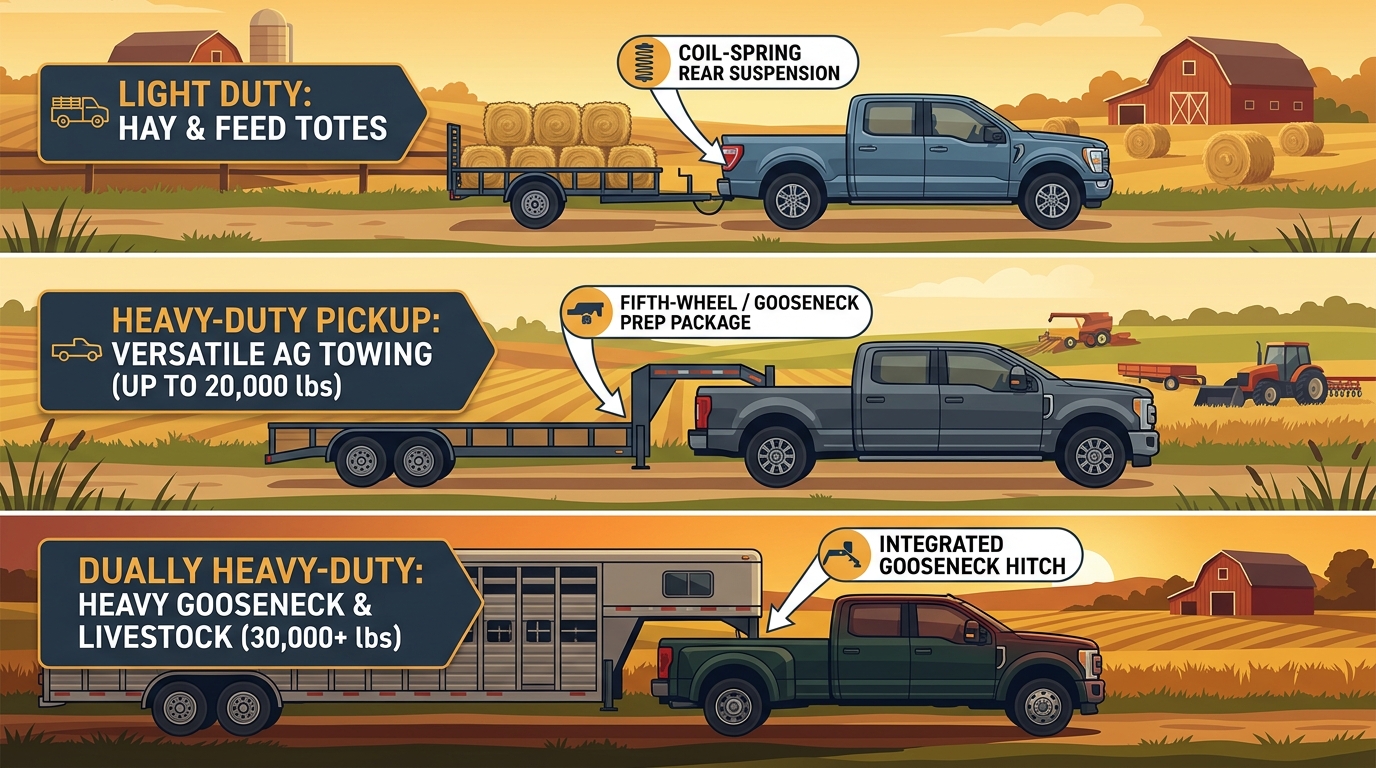
The Ram 2500 equipped with the 6.7L Cummins Turbo Diesel engine is the most versatile truck for agricultural towing, balancing a maximum trailer rating of up to 20,000 pounds with a class-exclusive coil-spring rear suspension. For lighter daily duties like moving hay bales and feed totes, the Ram 1500 offers up to 11,580 pounds of towing capacity. When operations demand hauling loaded gooseneck grain trailers or heavy machinery exceeding 30,000 pounds, the Ram 3500 dual-rear-wheel model delivers maximum capability.
Choosing the right truck depends on matching gross vehicle weight ratings and trailer types to daily farm demands. The Ram 1500, powered by either the 3.6L Pentastar V6 with eTorque or the high-output twin-turbo inline-six, handles light equipment flatbeds and utility trailers across agricultural properties in Waynesboro. Its light frame and maneuverability make it ideal for quick farm to market runs, but heavy tongue weights from livestock haulers require upgrading to a heavy-duty chassis.
The Ram 2500 bridges the gap between daily comfort and serious work. Available with either the standard 6.4L HEMI V8 gas engine or the legendary Cummins diesel, it features a rear coil-spring suspension that dampens rough field roads while carrying substantial loads. Adding the optional factory rear air suspension allows the truck to self-level under heavy tongue weights, ensuring headlights stay aligned and steering geometry remains stable when pulling tandem-axle trailers.
For maximum payload and towing, the Ram 3500 provides a solid rear axle with traditional leaf springs and an optional dual-rear-wheel configuration. Dual rear wheels supply extra lateral stability, preventing trailer sway when transporting tall cattle trailers or wide farm implements down rural highways. To test truck capabilities or discuss farm setup options, visit our Waynesboro showroom location or give our team a quick call at (762) 365-0910.
Table of Contents
- How Does the 6.7L Cummins Turbo Diesel Perform Under Heavy Farm Towing Loads?
- What Are the Payload and Bed Dimensions of the Ram Heavy Duty for Harvest Cargo?
- What Maintenance and Cooling Care Prevents Overheating During Autumn Towing?
- Does Ram Offer Agricultural Discounts or Farm Bureau Incentives?
- Common Questions About Ram Agricultural Towing and Setup
- Prepare Your Ram Truck for Harvest Season at Paul Thigpen CDJR Waynesboro
How Does the 6.7L Cummins Turbo Diesel Perform Under Heavy Farm Towing Loads?
Delivering 370 horsepower and 850 lb-ft of torque, the 6.7L Cummins Turbo Diesel engine excels at moving heavy farm loads from a standstill with impressive low-end power. In High-Output Ram Heavy Duty configurations, output increases to 430 horsepower and 1,075 lb-ft of torque, allowing operators to haul heavy agricultural machinery up steep grades without engine lugging or transmission gear hunting.
Unlike traditional V8 engines that require high engine speeds to reach peak power, the Cummins inline-six reaches its maximum torque at just 1,800 rpm. This low-rpm power band is designed specifically for sustained, high-load work. When pulling a fully loaded livestock trailer through soft soil or muddy field gates, the engine maintains consistent momentum without spinning tires or slipping the torque converter.
Durability under continuous thermal load is another key strength of the Cummins platform. Featuring a cast-iron block and cylinder head, structural stiffness handles high cylinder pressures created during long pulls under load. The engine is paired with a heavy-duty eight-speed automatic transmission designed with optimized gear ratios for smooth power delivery. Integrated smart exhaust braking lets drivers select full or auto modes, using engine backpressure to control downhill vehicle speed and dramatically reduce wear on brake pads and rotors.
When farmers inspect a heavy-duty truck on our lot, they usually want to examine the factory bed puck integration and check radiator clearance before taking a test drive. To find trucks equipped with this powerplant, shoppers can explore our current new Ram inventory to compare available engine configurations and axle ratios.
What Are the Payload and Bed Dimensions of the Ram Heavy Duty for Harvest Cargo?
The Ram 2500 delivers a maximum payload capacity of up to 4,420 pounds when equipped with the 6.4L HEMI V8 engine, while the Ram 3500 dual-rear-wheel regular cab model increases maximum payload to 7,680 pounds. Bed options include a 6-foot-4-inch bed providing 57 cubic feet of volume and an 8-foot bed delivering 74 cubic feet of space, both offering over 50 inches of clearance between the wheel wells to fit standard agricultural pallets flat.
Hauling harvest cargo requires understanding how bed dimensions translate to actual agricultural products. An 8-foot cargo bed easily accommodates two standard 40-by-48-inch seed pallets or chemical totes loaded side-by-side. The steel bed floor features integrated cargo tie-down loops rated for heavy straps, keeping fertilizer bags or seed boxes secure over uneven terrain around Hephzibah.
The table below breaks down cargo space and load limits across key Ram Heavy Duty configurations:
| Ram Truck Model | Bed Length | Max Cargo Volume | Max Payload (Gas Engine) | Max Payload (Diesel Engine) |
|---|---|---|---|---|
| Ram 2500 Crew Cab | 6-foot-4-inch | 57 cu ft | 3,120 lb | 2,390 lb |
| Ram 2500 Crew Cab | 8-foot | 74 cu ft | 3,610 lb | 3,060 lb |
| Ram 3500 DRW Regular Cab | 8-foot | 74 cu ft | 7,680 lb | 6,560 lb |
To assist with bed access during long workdays, Ram offers the bed utility group. This package includes an exterior 115-volt AC outlet capable of running power tools in the field, LED bed lighting under the box rails, and a deployable bed step that drops down with foot pressure. Buyers looking for capability on a budget can browse pre-owned heavy-duty models to find pre-equipped work trucks ready for immediate farm delivery.
What Maintenance and Cooling Care Prevents Overheating During Autumn Towing?
Preventing engine overheating during autumn harvest towing requires cleaning dust and chaff out of the radiator core, verifying coolant concentration levels, testing the electronic fan clutch, and replacing worn drive belts before pulling heavy loads. Field operations during dry harvest weeks kick up fine organic debris that quickly clogs the air-to-air intercooler and radiator fins, restricting air volume and causing operating temperatures to spike under load.
Routine harvest prep should always begin with a low-pressure air or water flush of the front cooling stack. Spraying from the engine side outward pushes accumulated chaff and dirt out of the radiator fins without bending the aluminum cooling louvers. Operators should also inspect the coolant mixture, keeping a 50/50 water-to-antifreeze ratio to maintain proper heat transfer and prevent corrosion inside the water jacket.
Key autumn cooling system maintenance items include:
- Blowing field debris out of radiator, intercooler, and transmission cooler fins using compressed air.
- Inspecting serpentine belts for cracking, fraying, or loss of tension that could cause water pump slippage.
- Checking the electronic fan clutch operation to ensure full engagement when engine temperatures climb under heavy tow loads.
- Replacing the engine air filter and cabin air filter after dusty field transport operations.
- Verifying transmission fluid levels and condition, as heat is the primary cause of automatic transmission wear.
Using Tow/Haul mode while pulling harvest trailers helps keep fluid temperatures lower by adjusting shift timing to prevent excessive gear hunting. This mode also locks the torque converter sooner, reducing fluid friction and keeping transmission fluid temperatures in a safe operating window. Owners looking for inspected vehicles that meet strict mechanical criteria can examine certified pre-owned options with full vehicle history reports.
Does Ram Offer Agricultural Discounts or Farm Bureau Incentives?
Ram provides specialized savings for farmers through participation in agricultural incentive programs, including an exclusive cash allowance—typically $500—for active American Farm Bureau members toward purchasing or leasing eligible new trucks. Qualifying farm owners can stack these member incentives with national consumer rebates and fleet programs to lower total vehicle acquisition costs.
In addition to direct cash allowances, eligible producers can take advantage of the Ram Certified Agriculture Program. Participating trucks can be upgraded with agricultural equipment packages that include heavy-duty bed liners, toolbox installations, and specialized farm accessories designed to withstand daily agricultural demands.
Managing farm equipment expenses requires maximizing trade-in equity when upgrading fleet vehicles. Owners preparing to trade in their current truck can value a trade-in online to estimate current market value before visiting our finance department. Combining trade-in values with Farm Bureau cash allowances helps agricultural businesses maintain modern, reliable transport fleets while controlling operational overhead.
Common Questions About Ram Agricultural Towing and Setup
Q: What is the maximum gooseneck towing capacity of the Ram 2500? When equipped with the 6.7L Cummins Turbo Diesel engine, a 3.42 or 3.73 rear axle ratio, and the factory gooseneck prep package, a properly configured Ram 2500 can tow up to 19,990 pounds via a gooseneck hitch. Always confirm exact weight ratings on the vehicle driver-side door jamb label before loading.
Q: How do you set up a gooseneck hitch using the factory prep package? Setting up a gooseneck hitch with the factory prep package requires inserting the ball into the bed center puck socket, locking the retention pin, placing the safety chain anchors into the outer bed pucks, and plugging the trailer 7-pin connector into the in-bed electrical outlet.
Q: Is the Ram 1500 or Ram 2500 better for daily farm operations? The Ram 1500 works best for light farm transport, field scouting, and pulling utility trailers under 10,000 pounds. The Ram 2500 is necessary when pulling heavy livestock trailers, equipment flatbeds, or gooseneck hitches that exceed half-ton payload and tongue weight limits.
Q: What roadside assistance services support agricultural Ram trucks towing heavy loads? New Ram trucks include 24/7 Roadside Assistance for 5 years or 60,000 miles (or 5 years/100,000 miles on diesel models). Services cover flat tire changes, towing to an authorized dealership, emergency fuel delivery, and lockout assistance across rural routes.
Q: How long does online financing pre-approval take before visiting the dealership? Completing our secure online finance application takes about five minutes. Buyers can apply for pre-approval online to get rate details and potential payment structures arranged before stepping foot on the lot.
Prepare Your Ram Truck for Harvest Season at Paul Thigpen CDJR Waynesboro
Preparing your truck for demanding fall harvest transport requires checking high-wear towing parts, servicing the engine cooling system, and installing factory-certified hitch accessories before heavy work begins. Our service center technicians inspect brake pads, test cooling systems, flush transmission fluids, and verify trailer brake wiring so your vehicle is ready to haul heavy loads dependably.
Our parts department stocks original equipment Mopar tow hitches, gooseneck ball kits, trailer brake modules, and heavy-duty air filters designed specifically for your Ram chassis. Farm managers looking for replacement maintenance parts can order genuine Mopar parts directly through our department for fast pickup.
Stop by our Waynesboro dealership today to speak with our truck specialists about your agricultural hauling needs, or call us at (762) 365-0910 to schedule your pre-harvest maintenance appointment.
© 2026 Paul Thigpen CDJR Waynesboro. All rights reserved.