



Trading in a vehicle applies its appraised market value directly as a financial credit toward purchasing your next automobile, functioning as an instant down payment. Our appraisal process evaluates your vehicle's mechanical condition, mileage, and current market demand, then deducts any existing loan balance to determine your net equity. That equity immediately reduces the vehicle purchase price, decreases overall financing costs, and lowers your monthly payments when browsing our new Chrysler, Dodge, Jeep, and Ram selection.
The mechanics of trading in a vehicle are designed to consolidate selling your old car and buying your new one into a single seamless transaction. Instead of listing a vehicle publicly, managing private test drives, and waiting weeks for a verified buyer, a dealership transaction handles the trade evaluation, title transfer, and loan payoff on the same day.
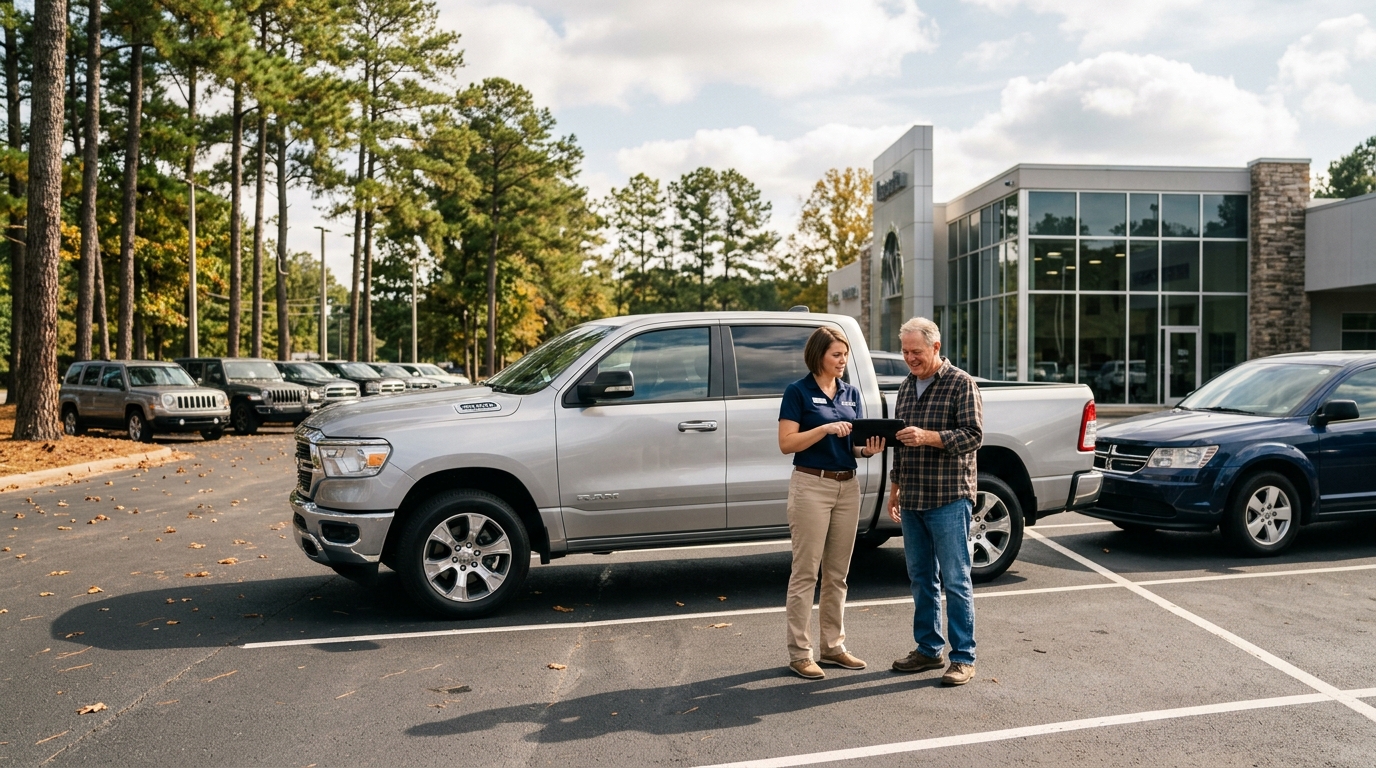
During the physical walk-around appraisal, our team reviews the interior, exterior paint, tires, and mechanical systems while running real-time market data to establish a fair trade allowance. For drivers traveling into our dealership along Highway 25 in Waynesboro, taking care of agricultural errands or family routines, trading in simplifies transitioning into a modern, dependable truck or SUV. If you want to discuss your vehicle options before heading out, give our team a quick call or stop by our Waynesboro showroom address to start the process.
Table of Contents
- Can You Trade In a Car With an Active Loan or Negative Equity for a New Ram 1500?
- How Does Trading In a Vehicle Reduce Georgia Sales Tax and Lower Ownership Costs?
- What Documents Do You Need and How Is Trade-In Value Calculated in Waynesboro?
- What Feature Options and Dimensions Does the Jeep Grand Cherokee Offer Upgrade Buyers?
- How Does the Jeep Compass Compare in Size and Performance to the Jeep Cherokee?
- Frequently Asked Questions About Vehicle Trade-Ins at Paul Thigpen CDJR
- Take the Next Step Toward Your Vehicle Upgrade
Can You Trade In a Car With an Active Loan or Negative Equity for a New Ram 1500?
Yes, you can trade in a vehicle with an active auto loan or negative equity when purchasing a new Ram 1500. If your official loan payoff balance is higher than the appraised trade value, the remaining balance can either be settled out-of-pocket or rolled into your new vehicle's loan financing with lender approval.
Carrying an existing loan balance is standard practice during vehicle trades. Our finance department contacts your current lender directly to request an official payoff quote, which details the exact amount needed to clear the title. If your vehicle is worth more than the loan balance, that positive equity transfers directly into your new loan structure to lower the total financed amount.
When you owe more than your vehicle's fair market value, known as negative equity, rolling that deficit into a light-duty or heavy-duty pickup loan allows you to complete the trade without paying thousands in cash upfront. However, carrying over negative equity increases the total principal balance of your new loan. To offset this difference, applying factory rebates, promotional incentives, or additional cash down payments keeps monthly obligations manageable. You can evaluate your purchasing power in advance by submitting our online form to get pre-approved for financing, or explore our pre-owned vehicle selection for budget-friendly alternatives.
How Does Trading In a Vehicle Reduce Georgia Sales Tax and Lower Ownership Costs?
Trading in a vehicle at a licensed Georgia dealership reduces your 7% Title Ad Valorem Tax (TAVT) by calculating the tax strictly on the net price difference between the new vehicle price and your trade-in credit.
Under Georgia tax law, the 7% TAVT is assessed on the taxable net amount rather than the full retail purchase price of the new vehicle. For example, if you choose a vehicle priced at $40,000 and receive an agreed trade-in allowance of $15,000, your taxable baseline drops to $25,000. That dollar-for-dollar reduction saves you $1,050 in state vehicle tax on that single transaction.
Private-party sales do not receive this state tax incentive. Selling your vehicle independently requires paying full TAVT on the replacement car while forcing you to handle title transfers, bill-of-sale documentation, and payment verification yourself. Combining trade-in tax savings with flexible financing terms makes upgrading into late-model inventory highly cost-effective, especially when browsing our certified pre-owned vehicles that come backed by factory warranty coverage.
What Documents Do You Need and How Is Trade-In Value Calculated in Waynesboro?
Trading in a car requires bringing a valid driver's license, current vehicle registration, proof of auto insurance, all sets of keys, and either the original physical title or loan payoff information. Valuations are calculated using real-time market data, VIN-based pricing guides, total mileage, vehicle history reports, and current physical condition.
Preparing your documentation before visiting the showroom ensures a seamless appraisal process. If your vehicle is paid off, bring the physical title free of unreleased liens. If you are still making payments, bringing your lender's contact information and account number allows our team to obtain a formal 10-day payoff quote immediately. Having complete service records on hand also helps substantiate proper mechanical care, which positively influences the final valuation.
Our professional appraisers examine several key areas to determine a vehicle's wholesale and retail value. Baseline values originate from regional market data guides like Black Book and J.D. Power, adjusted for equipment levels and mileage relative to national averages. Physical condition plays a substantial role; cosmetic blemishes, worn tires, or interior wear require reconditioning before resale. For vehicles driven regularly along the red clay roads of Hephzibah, minor exterior wear or undercarriage dirt can accumulate, so taking time to clean the vehicle prior to evaluation helps preserve its cosmetic rating. First-time trade-in buyers usually ask how quick the evaluation takes before discussing numbers, and an in-person walk-around usually wraps up in under 30 minutes. You can begin estimating your car's market standing today using our online tool to value your trade online.
What Feature Options and Dimensions Does the Jeep Grand Cherokee Offer Upgrade Buyers?
The Jeep Grand Cherokee lineup offers two-row and three-row L configurations powered by the 2.0L Hurricane 4 Turbo engine, delivering 324 hp and 332 lb-ft of torque alongside a maximum towing capacity of 6,200 lb.
Engineered for families needing versatility and capability, the cabin pairs executive comfort with advanced trail technology. The available 12.3-inch Uconnect 5 NAV touchscreen handles navigation, climate controls, and wireless smartphone integration, supported by available safety tech like the Hands-Free Active Driving Assist System. Multi-terrain capability is delivered through selectable Selec-Terrain traction management and available Quadra-Lift air suspension, which adjusts ground clearance for off-road obstacles or highway efficiency.
Dimensional choices allow buyers to match cabin space to household needs. The standard two-row model provides roomy seating for five with generous rear cargo space, while the three-row L variant expands capacity for up to seven passengers. With the rear seats folded flat, the three-row cabin accommodates bulky sports equipment, camping gear, or agricultural supplies with ease. Across the lineup, entry-level trims like the Laredo build a strong foundation of safety features, while top-tier packages elevate exterior styling with redesigned LED projector headlamps and premium interior materials.
How Does the Jeep Compass Compare in Size and Performance to the Jeep Cherokee?
The Jeep Compass is a compact SUV equipped with a standard 2.0-liter turbocharged four-cylinder engine producing 200 hp and 221 lb-ft of torque, while the slightly larger Jeep Cherokee sits in the midsize SUV segment with a longer wheelbase and higher maximum cargo volume.
Performance in the Jeep Compass comes standard across the lineup via an 8-speed automatic transmission and Jeep Active Drive 4x4, offering agile handling and an impressive 23 mpg combined rating. The compact footprint measures 173 inches in length, making it easy to maneuver through tight parking lots while maintaining a maximum towing capacity of 2,000 lb. By comparison, the Jeep Cherokee offers a wider stance and slightly larger exterior proportions, catering to buyers who prioritize extra shoulder room and expanded cargo dimensions.
Inside the cabin, the Jeep Compass makes clever use of its interior space. Rear passengers enjoy 38 inches of legroom, and cargo capacity expands from 27 cubic feet behind the second row up to 60 cubic feet when the rear seats are folded flat. Standard features across popular trims like the Latitude and Limited include a 10.1-inch Uconnect touchscreen, with specialized off-road variants like the Trailhawk adding specialized Falken WILDPEAK all-terrain tires, skid plates, and a crawler gear ratio.
Frequently Asked Questions About Vehicle Trade-Ins at Paul Thigpen CDJR
Q: Am I obligated to trade in my vehicle after receiving an appraisal at the dealership?
Receiving a professional trade appraisal carries no obligation to complete a trade-in or purchase a vehicle. Valuation quotes provide a transparent market offer valid for a specified window, allowing you time to decide whether to sell, trade, or retain your vehicle. If you choose not to proceed, there is no fee for the inspection or calculation service.
Q: Can I trade in a vehicle that needs mechanical repairs or body work?
Vehicles are accepted in various mechanical and physical conditions, including those needing minor body work or engine repairs. During the physical appraisal, estimated reconditioning and repair costs are factored into the valuation, resulting in an adjusted fair market offer. You can contact our team directly at (762) 365-0910 to discuss your vehicle's specific condition before visiting.
Q: Do non-factory aftermarket modifications increase my trade-in valuation?
Aftermarket modifications such as custom lift kits, non-standard wheels, or aftermarket exhausts generally do not increase trade value and can sometimes reduce broader market appeal. Dealerships prefer factory-standard equipment because it appeals to the widest range of pre-owned buyers and complies with original warranty parameters. Reinstalling original factory parts prior to an appraisal helps preserve maximum equity.
Q: What happens if my vehicle title lists multiple owners?
When a vehicle title lists multiple owners joined by the word "and," all named individuals must be present in person to sign the title transfer documentation. If the owners' names are joined on the title by "or," either owner can sign the documentation to legally complete the trade transaction. Our documentation team can verify your title structure prior to your appointment.
Q: How long is a written trade-in offer valid at the dealership?
Trade-in appraisal offers are guaranteed for 7 days or a specific mileage allowance, such as 250 miles. Because pre-owned market conditions, wholesale auction values, and regional inventory demand fluctuate continuously, appraisals are re-evaluated once the initial expiration window passes. You can plan your visit using our Waynesboro showroom address to lock in your offer.
Take the Next Step Toward Your Vehicle Upgrade
Dealerships often highlight trade-ins as a key strategy to decrease upfront expenses and monthly installments when buying a new vehicle. Whether you want to trade into a fuel-efficient compact crossover, an adventurous family SUV, or a heavy-duty pickup, our team provides transparent valuations based on real-time market data. Contact us today at (762) 365-0910 or visit our Waynesboro dealership location to complete your physical appraisal and explore our inventory.
Keep Your Vehicle Running Strong
Keep your vehicle performing at its best with our service team:
© 2026 Paul Thigpen CDJR Waynesboro. All rights reserved.