




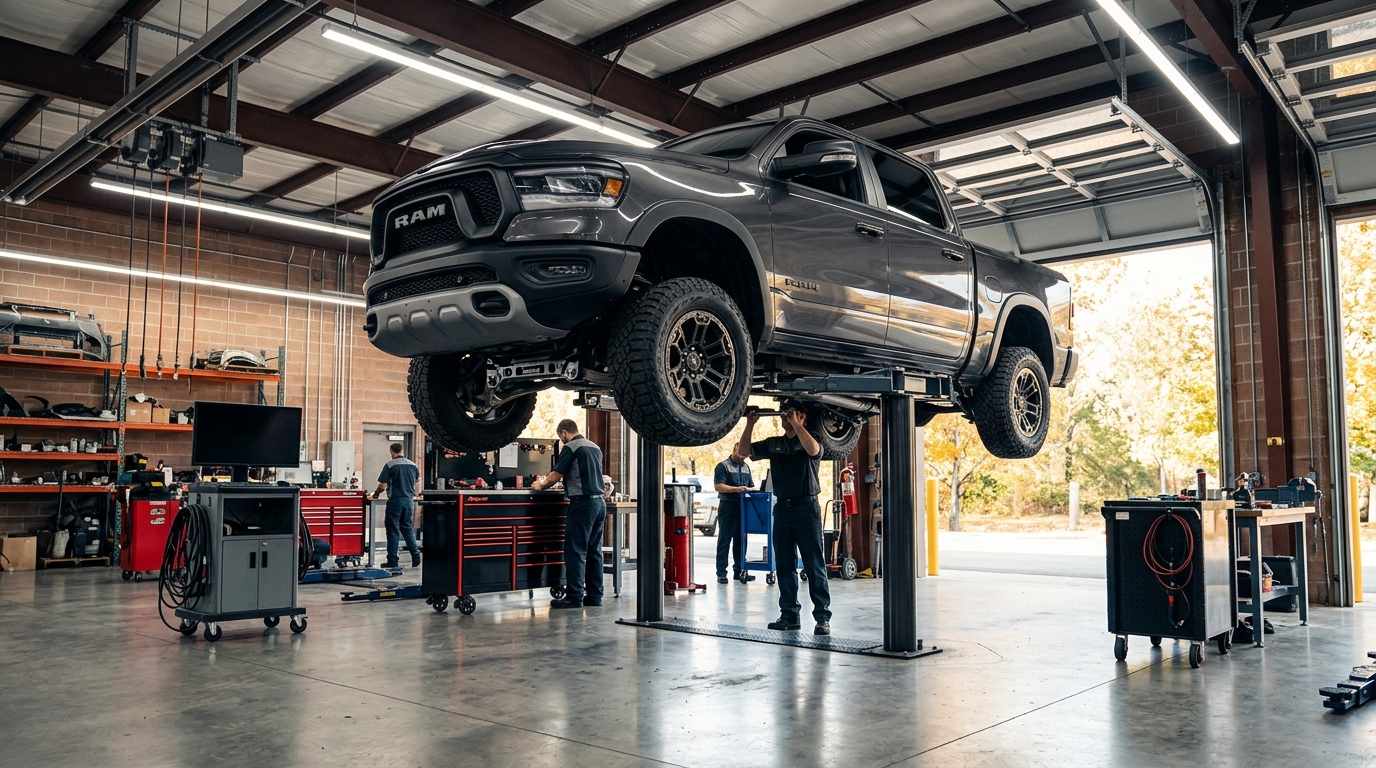
A 2026 Ram truck should be serviced every 8,000 to 10,000 miles or once every 12 months for standard driving with a gas engine, while trucks operated under severe duty or equipped with a diesel engine require service intervals ranging between 7,500 and 15,000 miles or 500 engine hours. Maintaining these intervals keeps your truck operating efficiently, protects your factory warranty coverage, and prevents premature wear on vital powertrain components.
The exact timing of routine service depends heavily on your truck's engine configuration and how you use the vehicle day to day. Modern Ram trucks feature an intelligent oil change indicator system that monitors engine load, operating temperatures, idle time, and driving conditions. When the dashboard indicator illuminates, service should be scheduled within 500 miles. However, you should never exceed 10,000 miles or 12 months between oil services, regardless of what the indicator reads.
Driving conditions play a major role in establishing your maintenance schedule. Truck owners involved in frequent agricultural hauling, heavy trailer towing, continuous stop-and-go driving, or driving on unpaved dusty roads in farming areas around Waynesboro fall into the severe-duty category. For these vehicles, shorter maintenance intervals—typically every 5,000 to 6,000 miles—are recommended for engine oil, fluid inspections, and filter changes to safeguard internal components against excessive heat and dirt accumulation.
Adhering to factory-recommended service milestones keeps your truck running smoothly while maintaining your coverage under the manufacturer warranty. Every 2026 Ram model is backed by a limited powertrain warranty of up to 10 years or 100,000 miles. To maintain this protection, all routine maintenance must be documented and completed according to OEM specifications. Additionally, Ram owners benefit from manufacturer-backed emergency support. If you experience an unexpected breakdown on the road, Ram Roadside Assistance: 1-800-521-2779 provides 24/7 emergency towing to authorized service centers, flat tire assistance, and fuel delivery.
When your truck is due for routine inspection or specialized maintenance, visiting our service center location ensures your vehicle receives certified care using factory diagnostics. If you have questions about your specific maintenance indicator alert, give our team a call at (762) 365-0910 to speak with a factory-trained technician.
Table of Contents
- What Is the Recommended Maintenance Schedule and 60,000-Mile Service for a Ram 1500?
- How Much Is a Routine Oil Change for a Ram 1500 and What Oil Does the 3.0L Hurricane Engine Use?
- What Is the Maintenance Schedule for a Ram 2500 6.7L Cummins Diesel and How Often Do Fuel Filters Need Replacement?
- When Should Transmission Fluid and Axle Fluids Be Changed in a Ram 1500?
- What Does the Ram Mopar Prepaid Maintenance Plan Cover?
- Frequently Asked Questions About Ram Truck Maintenance
- Schedule Professional Ram Service in Waynesboro
What Is the Recommended Maintenance Schedule and 60,000-Mile Service for a Ram 1500?
The recommended maintenance schedule for a 2026 Ram 1500 follows an 8,000-to-10,000-mile cycle for routine oil changes and tire rotations, culminating in a major 60,000-mile service that requires replacing spark plugs, changing air filters, and conducting thorough brake and drivetrain inspections. Following this structured routine protects performance across the lifecycle of your half-ton pickup.
Routine maintenance begins at the 8,000-to-10,000-mile milestone. During this baseline visit, technicians perform a synthetic oil and filter change, rotate all four tires to ensure even tread wear, inspect front and rear brake pads and rotors, check steering and suspension components, and top off essential engine fluids. Repeating this basic service every 10,000 miles prevents localized mechanical strain and keeps steering response sharp.
At the 20,000-mile mark, maintenance expands to include a comprehensive inspection of the front suspension, tie rod ends, and brake linings. Technicians also inspect the cabin air filter to maintain clean heating and air conditioning airflow inside the passenger cabin. By 30,000 miles, the engine air filter must be replaced to prevent dust build-up from restricting intake airflow, which can degrade fuel economy and engine output.
The 60,000-mile service represents a vital preventive milestone for every 2026 Ram 1500. This comprehensive service package includes:
- Replacement of engine oil and OEM oil filter
- Four-wheel tire rotation and tire pressure sensor check
- Installation of a new engine air filter and cabin air filter
- Inspection and replacement of spark plugs on select gas engines
- Comprehensive brake inspection, including pads, calipers, lines, and fluid condition
- Fluid level and clarity checks for the transfer case, front axle, and rear differential
- Inspection of drive belts, water pump, and cooling system hoses
Once your truck reaches 100,000 miles, additional long-term service items become due. This includes replacing spark plugs on extended-life engines, flushing and replacing the engine coolant, and inspecting CV joints and driveshaft boots. Following these structured intervals ensures your Ram 1500 delivers dependable performance for years to come.
How Much Is a Routine Oil Change for a Ram 1500 and What Oil Does the 3.0L Hurricane Engine Use?
A routine synthetic oil change for a gas-powered 2026 Ram 1500 typically costs between $80 and $130, while the twin-turbo 3.0L Hurricane engine requires full synthetic SAE 0W-20 engine oil that strictly meets Chrysler Material Standard MS-6395 or MS-13340. Oil change costs vary depending on engine size, oil capacity, and filter design, with specialized turbo and diesel setups requiring higher fluid volumes.
For trucks equipped with the standard 3.6L Pentastar V6 engine, fluid capacity sits at roughly 5 quarts, keeping routine maintenance costs on the lower end of the spectrum. However, modern powertrain additions like the twin-turbocharged 3.0L Hurricane inline-six engine demand specific oil formulations designed to withstand high operating temperatures and extreme mechanical stress. The dual turbochargers rely directly on engine oil for cooling and shaft bearing lubrication, making high-grade synthetic oil essential to prevent thermal breakdown and oil coking inside the turbo housings.
Using oil that does not meet the specified MS-6395 or MS-13340 standard can compromise engine protection, accelerate internal component wear, and potentially void coverage under your 10-year / 100,000-mile limited powertrain warranty. Modern full synthetic formulations maintain optimal viscosity in hot weather while flowing quickly during cold engine starts, ensuring immediate pressure buildup at the camshafts and turbo bearings.
Comparing gas and diesel oil change costs reveals noticeable differences in volume and component pricing:
| Engine Option | Recommended Oil Type | Oil Capacity | Typical Service Cost Range |
|---|---|---|---|
| 3.6L Pentastar V6 | Full Synthetic SAE 0W-20 / 5W-20 | ~5 Quarts | $80 – $110 |
| 3.0L Hurricane I6 | Full Synthetic SAE 0W-20 (MS-6395/MS-13340) | ~7.5 Quarts | $95 – $140 |
| 3.0L EcoDiesel V6 | Full Synthetic SAE 5W-40 Low-SAPS | ~10.5 Quarts | $150 – $220 |
| 6.7L Cummins Diesel | Premium Heavy-Duty 10W-30 / 5W-40 | ~12 Quarts | $170 – $250 |
Choosing genuine OEM Mopar oil filters during every service ensures proper internal bypass valve operation and correct filtration micron ratings. This protects precision hydraulic valve lifters and variable valve timing solenoids from microscopic engine debris.
What Is the Maintenance Schedule for a Ram 2500 6.7L Cummins Diesel and How Often Do Fuel Filters Need Replacement?
The 2026 Ram 2500 equipped with the 6.7L Cummins Turbo Diesel engine requires engine oil and filter changes every 15,000 miles or 500 engine hours, and both fuel filters must be replaced every 15,000 miles or at every other oil change. Heavy-duty diesel engines operate under immense cylinder pressure and high torque loads, demanding strict adherence to specialized fluid and filter service intervals.
The dual fuel filter system on the 6.7L Cummins engine features an under-hood primary filter and a chassis-mounted fuel/water separator filter. Together, these filters protect the high-pressure common-rail fuel injection system, which operates at pressures exceeding 29,000 psi. Microscopic dirt particles or water contamination in the fuel supply can cause severe injector erosion, misfires, or fuel pump damage. Replacing both filters simultaneously at every 15,000-mile interval ensures clean fuel delivery, especially for drivers hauling livestock trailers or heavy equipment across unpaved red clay roads around Hephzibah.
In addition to fuel system care, heavy-duty diesel ownership involves monitoring specific emissions and drivetrain components:
- Engine Oil and Filter: Change every 15,000 miles, 500 hours, or 12 months. Under severe towing conditions, reduce this interval to 7,500 miles.
- Dual Fuel Filters: Replace both the under-hood and chassis-mounted filters every 15,000 miles.
- Diesel Exhaust Fluid (DEF) Filter: Replace the DEF pump filter every 150,000 miles or if fluid contamination occurs.
- Engine Valve Lash Adjustment: Inspect and adjust valve clearance on the 6.7L Cummins I6 at 150,000 miles.
- Cooling System Service: Flush and refill engine coolant at 150,000 miles or 10 years.
Maintaining factory filter quality is paramount for high-output diesel engines. Truck owners performing maintenance can order genuine OEM Mopar parts to ensure replacement filters match factory flow rates and water separation specifications.
When Should Transmission Fluid and Axle Fluids Be Changed in a Ram 1500?
The standard 8-speed automatic transmission fluid in a 2026 Ram 1500 is classified as fill-for-life under normal highway driving conditions, but trucks used for heavy towing, off-roading, or commercial hauling should have their transmission, transfer case, and axle fluids inspected and serviced between 60,000 and 100,000 miles. Heavy-duty cycles generate elevated fluid temperatures that degrade protective additives over time.
Under light-duty driving, modern synthetic automatic transmission fluids maintain stable viscosity and resistance to oxidation across thousands of miles. However, towing heavy trailers causes torque converter slipping and heat generation, which speeds up fluid breakdown. During a professional transmission service, technicians replace the transmission pan—which houses an integrated fluid filter—and refill the unit with factory-approved synthetic automatic transmission fluid to preserve crisp gear shifts and clutch pack durability.
Front and rear axle (differential) fluid maintenance is equally important for four-wheel-drive trucks. Differential gear oil should be inspected for clarity and level every 20,000 miles. If your truck is routinely used to launch boats at river ramps or driven through deep water, axle fluids must be inspected immediately for water intrusion. Water-contaminated differential oil appears milky and loses its lubricating properties, leading to rapid bearing and ring-and-pinion gear wear.
Four-wheel-drive transfer case fluid should be serviced at 60,000 miles under severe-duty use or 100,000 miles under normal conditions. Fresh transfer case lubricant prevents chain stretch, bearing noise, and premature wear on internal engagement clutches.
What Does the Ram Mopar Prepaid Maintenance Plan Cover?
A Ram Mopar prepaid maintenance plan covers manufacturer-scheduled engine oil and filter changes, tire rotations, cabin and engine air filter replacements, and multi-point safety inspections performed exclusively by factory-trained technicians using genuine OEM parts. Investing in a prepaid plan locks in current service rates and simplifies vehicle ownership throughout the lifecycle of your truck.
Mopar offers flexible plan tiers, including Maximum Care and Added Care packages, tailored to match your anticipated driving mileage and ownership duration. Key benefits covered under standard Mopar maintenance plans include:
- Factory-scheduled synthetic engine oil and OEM filter replacements
- Four-wheel tire rotations and brake system safety checks
- Engine air filter and interior cabin air filter changes
- Comprehensive multi-point vehicle safety and fluid inspections
- Specialized diesel fuel filter replacement coverage on select heavy-duty packages
- Official service history logging stored directly within the Ram national service database
Prepaid plans eliminate out-of-pocket fluctuations for routine maintenance visits and ensure your truck is always serviced according to exact OEM procedures. Complete service records backed by genuine Mopar parts also help maintain higher resale and trade-in values down the road.
To select a prepaid maintenance plan structured around your driving habits, visit our local dealership address to speak with our service team. You can also give us a quick call to discuss plan options or review your truck's remaining factory warranty coverage.
Frequently Asked Questions About Ram Truck Maintenance
Q: Does skipping routine oil changes void my 2026 Ram warranty?
Failure to perform required engine maintenance according to the owner's manual schedule can jeopardize your coverage under the 10-year / 100,000-mile limited powertrain warranty. If an engine failure occurs due to oil sludge or thermal breakdown caused by neglected service, warranty claims may be denied. Keeping detailed service receipts and servicing your truck at certified dealerships protects your warranty status.
Q: How do I know when my Ram 1500 needs an oil change?
Your Ram 1500 features an automatic oil change indicator system that displays a notification on the instrument cluster screen when service is required. The system uses an algorithm based on engine revolutions, operating temperature, idle time, and trip duration. Once the message appears, service should be completed within 500 miles, and the indicator must never exceed 10,000 miles or 12 months between resets.
Q: What is included in a multi-point safety inspection for a Ram truck?
A multi-point inspection covers vital safety and mechanical systems across the truck. Factory technicians evaluate brake pad thickness, rotor surface condition, tire tread depth and wear patterns, battery cold-cranking capacity, steering linkages, ball joints, suspension shocks, drive belts, fluid levels, and exhaust system mountings to detect wear before minor issues turn into major breakdowns.
Q: Can I use conventional engine oil in my Ram 1500 gas engine?
Modern Ram engines, including the 3.0L Hurricane inline-six and 3.6L Pentastar V6, require synthetic blend or full synthetic oil meeting specific Chrysler Material Standards such as MS-6395 or MS-13340. Conventional oils lack the thermal stability and shear resistance needed for tight internal clearances and high-heat turbocharger lubrication. Using non-compliant oil can increase engine wear and void manufacturer protections.
Q: How often should I replace the battery in my Ram truck?
Ram truck batteries typically have a service life of 3 to 5 years. Summer heat, extreme cold, heavy accessory loads, and frequent short trips accelerate battery degradation. Having your battery load-tested during routine scheduled maintenance helps identify weak cells and dropping cold-cranking amps before a sudden failure leaves you stranded.
Schedule Professional Ram Service in Waynesboro
Keeping your 2026 Ram 1500, 2500, or 3500 running at peak capability requires consistent care from technicians who understand your truck inside and out. From routine synthetic oil changes for the 3.0L Hurricane engine to complex dual fuel filter services on the 6.7L Cummins Turbo Diesel, sticking to factory maintenance schedules safeguards engine performance, protects fuel efficiency, and preserves your 10-year / 100,000-mile limited powertrain warranty.
Our certified service department at Paul Thigpen CDJR Waynesboro is equipped with specialized Mopar diagnostic equipment, dedicated heavy-duty service bays, and a complete inventory of genuine OEM parts. Whether you need a 60,000-mile major service inspection, brake system maintenance, or guidance on Mopar prepaid maintenance coverage, our team is ready to deliver fast, thorough service tailored to your vehicle's exact requirements. Schedule your next maintenance appointment online today or visit our service center to keep your Ram truck ready for every job ahead.