

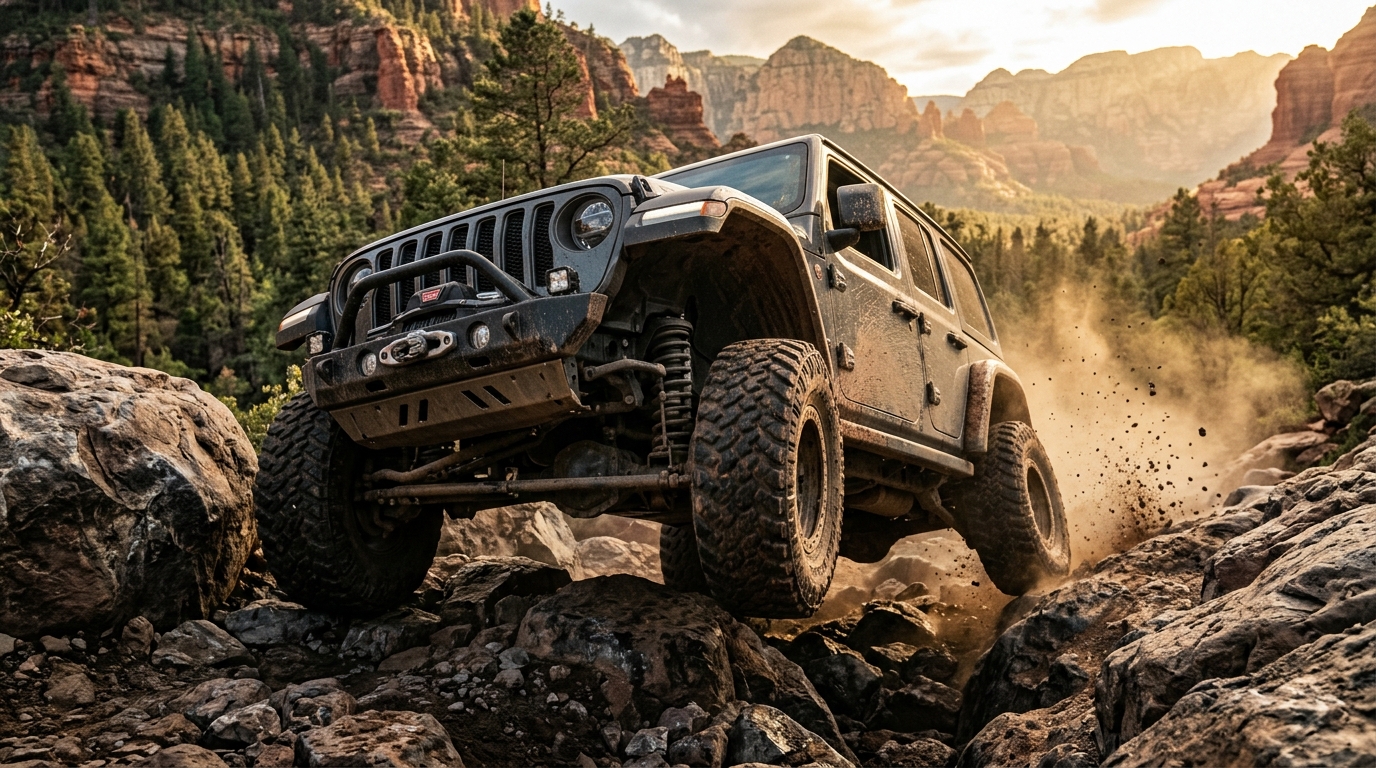
The 2026 Jeep Wrangler delivers extreme off-road capability through heavy-duty solid axles, mechanical 4x4 transfer cases, and up to 11 inches of ground clearance. Front and rear Tru-Lok electronic locking differentials enhance off-road traction by mechanically locking the left and right axle shafts together, forcing both wheels to turn at identical speeds regardless of surface resistance so power goes to the wheel with grip rather than spinning out in mud or loose rock.
Off-road capability on a 4x4 depends on how mechanically simple it is to force power to the tires that actually have traction. On a standard open differential, torque naturally follows the path of least resistance. If one tire loses contact with the trail or slips on loose sand, an open differential routes engine power to that slipping tire, leaving the wheel with ground contact stationary. By deploying electronic locking differentials, the axle shafts lock into a solid unit. This system guarantees equal torque delivery to both wheels on the axle, driving the vehicle forward even when a tire is lifted completely off the ground or buried in deep red clay.
In extreme terrain, suspension flexibility works alongside locking differentials to maintain maximum tire contact. The Rubicon trim features an Electronic Sway Bar Disconnect system that decouples the front sway bar with the push of a dash button. Disconnecting the sway bar allows the front axle to drop and compress independently, expanding front-wheel articulation to keep tires planted across severe ruts. Paired with available 35-inch factory tires, 4-door models achieve an approach angle of 47 degrees, a breakover angle of 32 degrees, and a departure angle of 40 degrees. This geometry allows the chassis to climb steep inclines and clear high obstacles without scraping the front steel bumper or underbody skid plates.
The agricultural acreage and unpaved farm lanes surrounding Waynesboro showcase why these hardware features matter during daily heavy-duty use. Traversing washed-out access tracks or muddy field borders requires continuous low-speed torque distribution. The available Rock-Trac 4x4 system provides a 4:1 low-range gear ratio, yielding a crawl ratio up to 100:1 when paired with the 6-speed manual transmission and a 4.88:1 rear axle ratio. This gearing delivers precise low-speed control over steep washouts without overheating the braking system. To explore available models in person, stop by our Waynesboro showroom or give our team a quick call to learn more about trail-tested capability options.
Table of Contents
- What Are the Key Engine Outputs and 0 to 60 Times for the 2026 Jeep Wrangler?
- How Do 0 to 60 MPH Times Compare Between the Wrangler Rubicon 392 and Bronco Raptor?
- How Much Can a Jeep Wrangler Tow and What Equipment Is Required for Maximum Capacity?
- How Does Rubicon 392 Fuel Economy Compare to Standard Wranglers and Is It Worth the Price?
- Common Buyer Questions About 2026 Jeep Wrangler Performance
- Testing Jeep Wrangler Performance at Paul Thigpen CDJR
What Are the Key Engine Outputs and 0 to 60 Times for the 2026 Jeep Wrangler?
The 2026 Jeep Wrangler offers three distinct gasoline engines alongside a plug-in hybrid option, delivering horsepower ratings from 270 hp up to 470 hp and 0 to 60 mph times between 4.0 seconds and 7.5 seconds. The base engine is a 3.6-liter Pentastar V6 generating 285 hp and 260 lb-ft of torque, while an available 2.0-liter turbocharged four-cylinder produces 270 hp and 295 lb-ft of torque. Range-topping performance comes from the 6.4-liter HEMI V8 in the Rubicon 392, generating 470 hp and 470 lb-ft of torque.
Powertrain selection dictates both transmission availability and quickness on pavement. The 3.6-liter Pentastar V6 comes standard with a 6-speed manual transmission, which accelerates a 2-door model from 0 to 60 mph in roughly 6.1 seconds, while an optional 8-speed automatic yields a 0 to 60 time of around 7.5 seconds in 4-door configurations. The 2.0-liter turbocharged four-cylinder connects exclusively to the 8-speed automatic, leveraging its low-end 295 lb-ft of torque to sprint from 0 to 60 mph in 6.5 seconds in light-duty trims like the Sahara.
For maximum acceleration, the 6.4-liter HEMI V8 powers the Rubicon 392 from 0 to 60 mph in just 4.0 seconds, completing the quarter-mile in 12.9 seconds. Buyers interested in electrified torque can choose the 4xe plug-in hybrid setup, which combines the turbo four-cylinder with an electric motor to generate 375 hp and 470 lb-ft of torque, hitting 60 mph in 6.8 seconds while offering an EPA-estimated 49 MPGe combined rating.
Drivers navigating the damp back roads and red clay routes near Hephzibah often appreciate how the turbo four-cylinder's low-end torque kicks in at low engine speeds, providing immediate push through heavy mud without needing high rpm momentum. If you are comparing performance figures across pre-owned model years, feel free to inspect our inventory of pre-owned vehicles to compare different powertrain generations.
How Do 0 to 60 MPH Times Compare Between the Wrangler Rubicon 392 and Bronco Raptor?
The Rubicon 392 reaches 0 to 60 mph in 4.0 seconds, outrunning the Ford Bronco Raptor's 5.6-second 0 to 60 mph acceleration by 1.6 seconds. This performance advantage stems directly from the Jeep's naturally aspirated 6.4-liter HEMI V8 engine, which produces 470 hp and 470 lb-ft of torque compared to the Bronco Raptor's 3.0-liter twin-turbo V6 output of 418 hp and 440 lb-ft of torque.
On paper and on pavement, the Rubicon 392 relies on displacement and immediate throttle response. Because it utilizes a high-displacement V8, power delivery is linear across the RPM band with zero turbocharger lag. The 8-speed automatic transmission features revised shift logic for aggressive launches, sending continuous power through a full-time transfer case to all four wheels. This powertrain configuration allows the vehicle to sprint down a straightaway with the acceleration profile of a high-performance sports car while maintaining solid front and rear Dana 44 axles under the frame.
The Ford Bronco Raptor uses a smaller-displacement twin-turbo V6 engine tuned for high-speed desert running. While its long-travel independent front suspension provides high-speed stability over desert dunes, the spool-up time of twin turbochargers and lower overall horsepower slow its initial launch from a standstill. The Rubicon 392 delivers 52 additional horsepower and 30 extra lb-ft of torque, translating to immediate pull off the line. Shoppers seeking severe-duty performance backed by factory coverage can browse our certified pre-owned lineup to review high-output models that have passed rigorous factory inspections.
How Much Can a Jeep Wrangler Tow and What Equipment Is Required for Maximum Capacity?
Maximum towing capacity on the 2026 Jeep Wrangler ranges from 2,000 pounds on 2-door models up to 5,000 pounds on properly equipped 4-door Rubicon models. Reaching the peak 5,000-pound maximum towing capacity requires a 4-door chassis, the factory Trailer Tow and Heavy-Duty Electrical Group package, a Class IV receiver hitch, and a heavy-duty full-float Dana 44 rear axle.
Towing performance depends heavily on body style, axle design, and factory packages. Standard 2-door models feature a shorter 97-inch wheelbase, which limits stability under heavy trailer loads and caps towing capacity at 2,000 pounds. Selecting a 4-door model expands the wheelbase to 118 inches, raising standard capacity to 3,500 pounds. To achieve the maximum 5,000-pound rating on 4-door Rubicon models, Jeep engineered a heavy-duty full-float rear axle setup. Unlike semi-float axles that bear vehicle weight directly on the axle shaft, a full-float axle transfers the weight of the vehicle to a spindle mounted to the wheel hub. This mechanical separation isolates the drive shaft from bending forces, dramatically increasing load-bearing strength.
To safely operate at maximum capacity, specific factory trailering equipment must be installed:
- Class IV receiver hitch with 7-pin and 4-pin wiring harnesses
- Heavy-duty engine cooling fan and high-output 240-amp alternator
- Auxiliary dash-mounted switches for electric trailer brake controllers
- Dana 44 full-float rear axle with a 4.10:1 or 4.88:1 rear axle ratio
When customers stop in to discuss hauling utility trailers or small boats, our team usually walks them through the axle tag specs to confirm whether a model has the full-float rear end required for heavy trailering. Drivers planning to haul utility trailers or recreational equipment can begin by valuing your trade online to upgrade toward a maximum-capacity towing rig.
How Does Rubicon 392 Fuel Economy Compare to Standard Wranglers and Is It Worth the Price?
The Rubicon 392 earns an EPA-estimated fuel economy rating of 13 mpg city / 16 mpg highway, compared to standard Wranglers powered by the 2.0-liter turbocharged four-cylinder that reach up to 20 mpg city / 23 mpg highway and 21 mpg combined. For buyers seeking high-performance off-roading, the Rubicon 392 justifies its premium price by including factory upgrades—such as a 470-hp V8, FOX monotube shocks, a functional hydro-guide hood scoop, and a dual-mode performance exhaust—that would cost significantly more to replicate using aftermarket parts.
The fuel economy trade-off is substantial when opting for V8 power. A standard turbo four-cylinder or Pentastar V6 model offers a practical daily driving profile, with highway driving ranges exceeding 400 miles on a single tank of fuel. The 6.4-liter V8 engine in the 392 requires premium fuel and maintains a continuous 4x4 engagement system, dropping real-world highway range closer to 280 miles. However, the price premium for the 392 delivers factory-backed hardware that retains full vehicle warranty coverage.
Key performance features exclusive to the Rubicon 392 include:
- Factory 6.4-liter HEMI V8 engine producing 470 hp and 470 lb-ft of torque
- FOX 2.0 performance monotube shock absorbers with a 1-inch factory lift
- Hydro-guide air intake system capable of separating up to 15 gallons of water per minute from engine intake air
- Heavy-duty cast iron steering knuckles and upgraded chassis crossmembers
- Dual-mode quad-tip exhaust system with switchable performance baffles
For enthusiasts who want maximum speed and capability out of the box, building a baseline 4x4 to this level using third-party components risks voiding factory powertrain protections. If you prefer to customize your vehicle with official accessories, explore our genuine Mopar performance parts catalog for factory-backed upgrades.
Common Buyer Questions About 2026 Jeep Wrangler Performance
Q: Which 2026 Jeep Wrangler engine provides the best balance of fuel economy and power?
Among the engine options, the 2.0-liter turbocharged four-cylinder stands out for its efficiency and daily usability. Generating 270 hp and 295 lb-ft of torque, it offers more low-end torque than the standard V6 while earning up to 20 mpg city / 23 mpg highway. Its immediate torque delivery at low engine speeds makes it ideal for navigating both city traffic and unpaved off-road trails.
Q: Do I need front and rear electronic locking differentials for light off-roading?
Light off-roading on flat dirt roads or gravel paths does not require electronic locking differentials. Standard Command-Trac part-time 4x4 systems provide excellent traction for light trails by transferring power equally to both front and rear axles. Electronic locking differentials are designed for severe off-roading, such as climbing steep rock ledges, crossing deep mud ruts, or clearing off-camber obstacles where wheels lose ground contact.
Q: What is the difference between Command-Trac and Rock-Trac 4x4 systems?
The Command-Trac system features a 2.72:1 low-range gear ratio suitable for standard off-roading and slick road conditions. The Rock-Trac system, standard on Rubicon models, uses a heavy-duty 4:1 low-range gear ratio that delivers exceptional low-speed control and a crawl ratio up to 100:1. Rock-Trac allows the driver to creep slowly over large boulders without slipping the clutch or dragging the brakes.
Q: Can any 2026 Jeep Wrangler be flat-towed behind a motorhome?
Yes, standard Jeep Wrangler models equipped with Command-Trac or Rock-Trac part-time 4x4 systems can be flat-towed with all four wheels on the ground. The manual transfer case includes a true neutral position that disconnects the transmission and driveshafts, allowing the vehicle to be towed safely without accumulating odometer mileage or damaging internal driveline components.
Q: What warranty coverage protects the 2026 Jeep Wrangler powertrain?
Every 2026 Jeep Wrangler comes protected by a standard factory 3-year/36,000-mile bumper-to-bumper limited warranty and a 5-year/60,000-mile powertrain limited warranty. Powertrain coverage includes internal engine components, transmission assemblies, transfer cases, and front and rear axle systems, providing peace of mind whether driving on local highways or exploring off-road trails.
Testing Jeep Wrangler Performance at Paul Thigpen CDJR
Experiencing the performance, suspension articulation, and powertrain options of the 2026 Jeep Wrangler requires a hands-on test drive. At Paul Thigpen CDJR Waynesboro, our team helps buyers select the exact engine, gearing, and axle configuration necessary for their specific trail or towing demands.
Whether you need a daily commuter equipped with the efficient turbo four-cylinder or a Trail Rated Rubicon 392 built to tackle extreme rock crawling, our staff maintains a comprehensive selection of models ready for evaluation. You can review our current stock of new models by visiting our new Jeep Wrangler inventory online, or get a head start on purchase paperwork by submitting an online credit application prior to your showroom visit.
Visit our dealership at 480 US, Waynesboro, GA 30830 to test drive your preferred trim level, or call our sales desk directly at (762) 365-0910 to schedule a dedicated walk-around with one of our Jeep specialists.